ALPR Data Monetization for Smart Cities

ALPR Data Monetization for Smart Cities
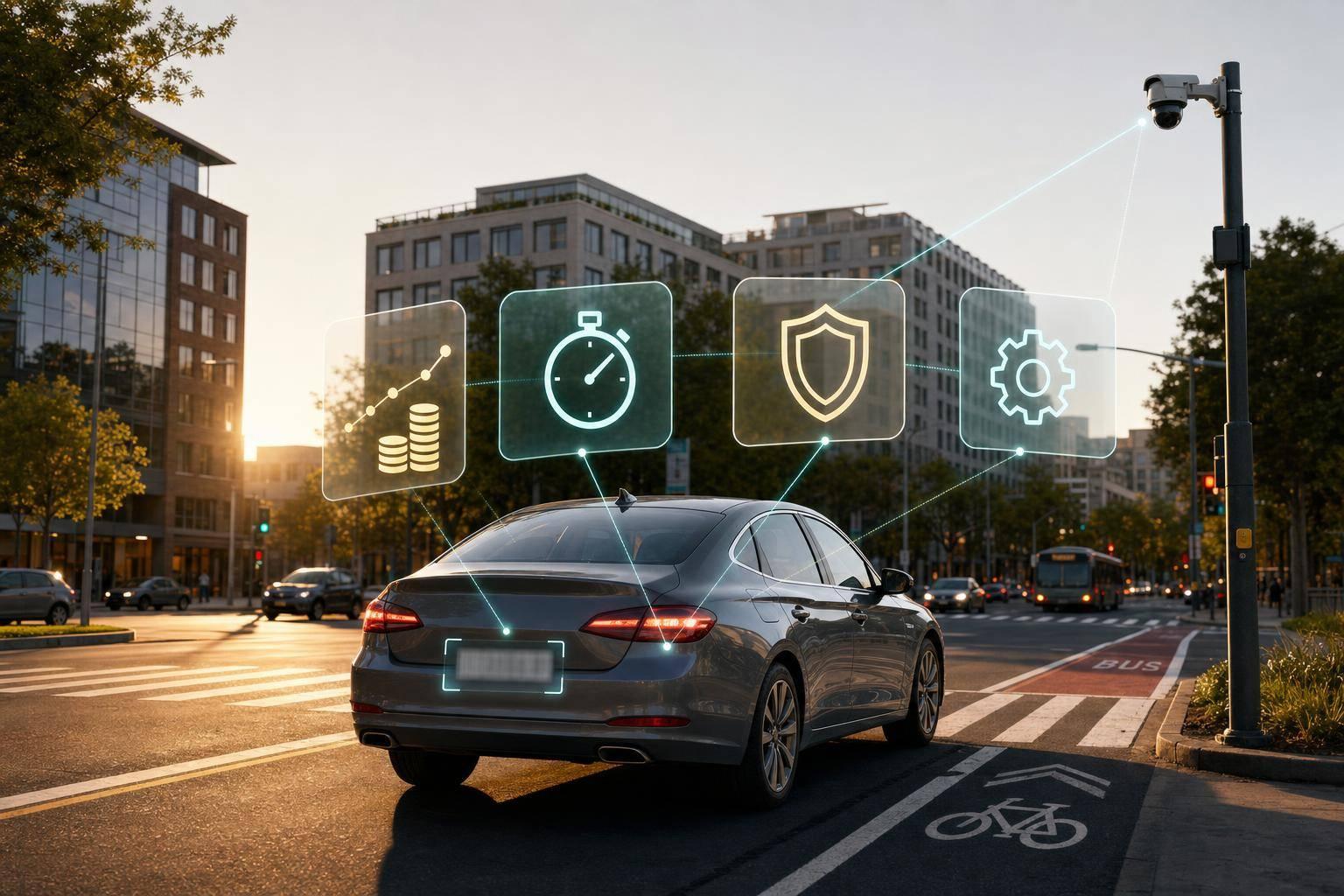
One plate read can return 15+ vehicle data points in about 120 ms - and that gives cities four main ways to turn ALPR into money or cost savings.
If I had to boil this article down fast, here’s the answer: direct municipal licensing brings the most revenue, API-based enrichment is the fastest to launch, PPPs split work and income, and cost-recovery is the simplest starting point for smaller cities.
Here’s the full picture in plain English:
- API enrichment and licensing turns each plate read into a paid lookup through a vehicle data API
- Direct municipal licensing means the city keeps the data and sells access itself
- Public-private partnerships (PPPs) let the city keep oversight while a private firm handles packaging and sales
- Cost-recovery skips outside sales and focuses on lower costs in parking, tolling, and fleet work
The main trade-offs are simple:
- More revenue usually means more legal, contract, and data work
- More control usually means a slower rollout
- Less sensitive data usually means lower privacy risk
- Smaller cities often fit cost-recovery or PPPs first
- Larger cities with more plate-read volume may be able to support API or direct licensing models
Quick Comparison
ALPR Data Monetization Models: Revenue, Control & Speed Compared
Model Main Money Source Control Privacy Risk Time to Launch Best Fit API enrichment Subscriptions, per-call fees Medium Medium Fast Large or mid-size cities that want a simple setup Direct municipal licensing Data sales, bulk deals, API access High Medium to high Slow Cities with mature ALPR programs and legal support PPP Shared revenue Medium Medium Medium to fast Mid-size cities with limited internal staff Cost-recovery Lower costs, better workflow output High Low to medium Fast Small cities, parking groups, tolling agencies
Bottom line: if you want the highest upside, direct licensing stands out. If you want the easiest path to start, cost-recovery is often the better move. If you want a middle option, a PPP can make sense. And if you want to get live without building a full data stack, API enrichment is usually the clearest route.
sbb-itb-9525efd
1. CarsXE-Style API Enrichment and Licensing
An ALPR camera reads a plate, sends that string to a vehicle data API, and gets back a JSON vehicle profile in about 120 ms. That response can include more than 15 data points, such as VIN, make, model, year, trim, fuel type, and engine specs [2][5]. In practice, each plate read becomes a billable data event. Once that read is enriched, the next issue is simple: how does a city pay for that volume?
CarsXE is a clear example of this setup. Its License Plate Decoder API supports more than 50 countries and combines plate decoding, VIN decoding, factory specs, and recalls into a single query [4]. That matters because it cuts out the need to stitch together several vendor contracts across city enforcement and mobility work.
Revenue Structure
Pricing tends to work best with tiered subscriptions. Starter and Pro plans line up well with steady municipal workloads, while Business pricing fits high-volume use or custom integrations. If a city has stable enforcement activity month after month, a fixed subscription makes budgeting easier. If traffic swings with tourism, events, or seasonal spikes, overage billing or per-call pricing usually makes more sense [1][3].
Data Granularity and Privacy Risk
More revenue does not mean cities can pull every data field available. The returned data has to stay within acceptable privacy limits. And not all enrichment carries the same legal risk. Some endpoints may return personally identifiable information, which can trigger added compliance duties if that data is relicensed to third parties [2].
Granularity Level Privacy Exposure Primary Use Case Vehicle attributes (make, model, VIN) Medium Parking enforcement, insurtech, dealerships Aggregated traffic insights Low Urban planning, mobility analytics Anonymized trend data Minimal Market research, environmental agencies
Implementation Burden
This model is easier to deploy than building a city-run vehicle data stack from scratch. Setup is self-serve, with API-key authentication, clean REST docs, and multiple SDKs [5][7]. Cities without big IT teams can also connect ALPR data to current dashboards through no-code tools, which cuts custom development work [7]. Uptime is listed at 99.9%, and the provider runs the backend infrastructure [5]. For a city that wants a fast rollout, that can be a strong selling point.
The downside is vendor dependence. A city gives up some control over data freshness, uptime, and schema changes. For many mid-sized municipalities, that's a fair trade if the goal is to get the system live fast. That dependence on an outside provider is the main tradeoff when compared with city-owned licensing models.
2. Direct Municipal ALPR Data Licensing
In this setup, the city owns the data and sells access to it directly. It becomes the vendor, licensing ALPR data to buyers like insurers, parking operators, and fleet managers. The city decides which fields are available, who gets access, and what each buyer pays. This model tends to work best when parking, curb activity, tolling, or enforcement already produce a steady flow of reads.
Revenue Structure
Pricing usually depends on the buyer and how often they query the data. Buyers with constant lookups, like smart parking apps or valet services, are often a strong fit for pay-per-call API access. Each live plate lookup creates a small transaction fee.
Insurance carriers and market analytics firms usually lean toward bulk agreements. The tradeoff is simple: they commit to larger data volume in exchange for lower per-record pricing.
Fleet management and warranty services often fit a monthly subscription model. That setup usually includes fixed usage quotas, with overage billing when demand jumps.
Pricing Model Best-Fit Use Case Revenue Driver Subscription Fleet management, logistics Recurring monthly fees + overage charges Per-Record/API Smart parking, valet apps High-frequency real-time transaction fees Bulk Insurance, market analytics Large-scale data licensing for historical analysis
Data Granularity and Privacy Risk
What a city can license depends on what sits inside the dataset. Decoded vehicle specs - make, model, year, VIN, fuel type, engine size, transmission, and similar fields - bring a moderate privacy risk. At the same time, they support use cases like market valuation and parts matching.
Plate-level data sits at the high end of privacy risk. That kind of access calls for enterprise-grade security controls, including SOC 2 Type II compliance and strong encryption [8].
At the safer end, Year/Make/Model (YMM) data without a VIN or plate number attached is the lowest-risk option to share. It can still support work like general safety recall research or market research [8].
In the U.S., licensing usually stops at vehicle specs and VIN-linked data [2].
Implementation Burden
Direct licensing gives a city more control, but it also puts more work on the city's side. The city has to build and maintain data pipelines, negotiate contracts, and keep the data current. If the data turns stale or inconsistent, buyer trust can drop fast [4].
There’s also the business side. Procurement cycles and minimum commitments can slow the path to revenue [4]. So while direct licensing keeps ownership and revenue in-house, it also asks for a serious operational lift. For cities that want help with execution without handing over ownership, PPPs can ease that load.
3. Public-Private Partnership (PPP) ALPR Monetization
PPPs sit in the middle ground between city-owned licensing and fully outsourced API models. In this setup, the city keeps control of the data stream, while a private partner handles enrichment, packaging, and resale to buyers like insurers, lenders, fleet operators, and dealers [1][4]. Put simply: the city provides the data, and the partner turns it into a product under terms set in the contract.
Revenue Structure
The city gets an agreed share of licensing revenue, and the partner sells access through APIs. That means the contract matters more than who owns the platform. It also helps speed things up. Modern vehicle data APIs can go live in weeks, not the months that municipal procurement cycles often take [4].
That’s the core appeal of the PPP model:
- Shared revenue
- Faster deployment
- Outsourced technical execution
Data Granularity and Privacy Risk
PPP monetization works best when the focus is on enriched vehicle specs, not owner-linked PII. A plate read on its own has limited value. The value grows when it’s paired with vehicle data such as make, model, year, VIN, fuel type, and market value. That kind of data supports insurance underwriting, auto financing, EV infrastructure planning, and fleet analytics [2][8].
In the U.S., plate decoders usually return vehicle-specific data instead of owner PII, which makes enriched specs the main monetization target [2]. That’s an important line to hold. The more the model leans on vehicle attributes instead of personal identity, the easier it is to see where the business case comes from.
Implementation Burden
This is where PPPs stand out from direct municipal licensing. The private partner takes on most of the technical work, while the city stays focused on governance and contract oversight. That split can save a lot of time and internal effort.
A PPP agreement should require SOC 2 Type II controls and 256-bit SSL encryption to help manage privacy risk [8]. CarsXE brings VIN decoding, specs, valuations, and history reports into one API, which cuts down on custom development for PPP launches [4].
When cities want value without direct data sales, the next option is cost recovery through operational gains.
4. Operational Cost-Recovery and Indirect Revenue Optimization
When a city isn't trying to make money from direct licensing or a PPP, ALPR can still pay off in another way: lower costs. In this model, the city does not sell ALPR data. Instead, it uses the data in-house to trim expenses, improve service, and get value through day-to-day efficiency. The tradeoff is pretty simple: less direct revenue, but faster rollout and less admin work.
Revenue Structure
Here, the return shows up as savings and workflow gains across city departments. Parking apps, smart garages, and valet services can use precise vehicle data to increase revenue and support urban mobility operations [1]. Municipal fleet teams can use vehicle specs, history, and recall data to cut maintenance risk and avoid expensive downtime [1].
This setup is easier to run with subscription APIs. Entry-level access can start at about $99/month, with usage-based billing tied to API requests, data egress, and compute seconds [4][9].
Because the value comes from operations, not resale, the city usually doesn't need the same depth of data as it would in a resale model.
Data Granularity and Privacy Risk
This model works best with enriched vehicle specs rather than owner-linked records. Plate reads combined with VIN, fuel type, engine size, and trim level can support congestion pricing and fleet compliance checks without adding much privacy exposure [2]. Event-level enriched data can guide operational choices while keeping risk in check when owner PII is left out [2].
Implementation Burden
The lighter technical lift is a big reason this model fits smaller cities. Small departments can connect ALPR data to current workflows with no-code tools [7]. Teams that need custom setups can use SDKs in Go, Java, .NET, and Python [7].
For fleet work, batch recall processing can handle up to 10,000 VINs in one request [6]. That makes citywide compliance checks a lot easier to run at scale.
Pros and Cons of Each ALPR Monetization Strategy
Each model balances revenue, control, speed, and risk in a different way. The right choice usually comes down to a city's size, legal capacity, and how far along its ALPR program is.
The basic trade-off is pretty clear: the more money a model can bring in, the more time, oversight, or control it tends to demand.
Revenue Upside vs. Implementation Cost
API enrichment is the least expensive model to get off the ground. Direct municipal licensing has the biggest revenue ceiling, but it also tends to take the longest to close. One direct licensing contract can reach $100,000 to over $1,000,000 [4]. PPPs split both revenue and infrastructure cost. Cost-recovery doesn't create direct licensing income at all; the upside comes from day-to-day operational savings.
Data Control vs. Deployment Speed
API models are usually the fastest to launch. Direct licensing gives cities the most control, but that control comes with more legal review and procurement work, which slows things down. PPPs can move faster because the vendor handles much of the execution. Cost-recovery is often the fastest path when a city can plug it into workflows that already exist.
Privacy Exposure vs. Monetization Flexibility
Raw plate-level data linked to owner records carries the highest legal risk and calls for the strongest compliance setup [2]. Tokenized or aggregated outputs lower privacy exposure, but they also limit who will buy the data. API enrichment sits in the middle. It lets cities monetize vehicle attributes without sharing full plate-level records. For PPP and direct licensing models that use raw data, cities need clear data governance rules before launch.
Those risk levels shape which cities are in a position to move first.
Best-Fit Use Case by City Type
Monetization Model Best-Fit City Type Primary Financial Driver Key Trade-Off API Enrichment & Licensing Large metros with high plate-read volume Recurring subscriptions from insurers, lenders, and auto-tech buyers Fast to deploy, but needs data pipeline investment Direct Municipal Licensing Cities with mature ALPR networks and legal frameworks High-value data sales ($100,000-$1,000,000+ contracts) [4] High revenue ceiling, slow to launch Public-Private Partnership Mid-size cities with limited internal IT staff Shared revenue, lower upfront cost risk Vendor-led speed, less municipal control Operational Cost-Recovery Small municipalities, parking and tolling authorities Indirect gains from enforcement and parking/tolling efficiency Low overhead, no direct revenue stream
The pattern in the table is hard to miss: smaller cities usually lean toward cost-recovery, while larger metros are more likely to justify API enrichment or direct licensing. City size, legal maturity, and ALPR scale are what decide which model is actually workable.
Conclusion
The right ALPR monetization model comes down to three things: who controls the data, how fast the city needs to launch, and how much compliance work it can handle. Different models fit different city conditions. In practice, city size, internal capacity, and data governance shape the best choice. CarsXE-style API enrichment helps turn raw plate reads into structured vehicle data that cities can use in revenue-driven workflows.
Direct licensing has the highest upside. API enrichment is the fastest to scale. PPPs offer a middle ground between speed and control. Cost-recovery is the easiest place to start. The best fit depends on a city’s revenue goals, compliance capacity, and how sensitive the data is.
If a city isn’t ready for the legal and technical load that comes with direct licensing, cost-recovery or a PPP is often the smarter starting point. As internal capacity grows, higher-revenue models become more workable.
The strongest model is the one that turns plate reads into usable city value without stretching legal or technical capacity too far.
FAQs
How much ALPR data volume is needed to make monetization viable?
There’s no fixed minimum amount of ALPR data you need before you can start making money from it. You can begin with small tests, see what works, and scale up as your business grows.
CarsXE makes that easier with a scalable model that supports up to 2,000,000 API calls per day. That means platforms can process license plate images in a dependable way without having to build complicated in-house AI systems.
What legal approvals should a city secure before licensing ALPR data?
Before licensing ALPR data, cities need the right legal and compliance sign-off to protect privacy and keep data secure. In the U.S., that means following the DPPA, which limits the use of personal information from motor vehicle records to legitimate purposes.
Cities also need to check state-level rules. Those rules may call for licenses, signed agreements, or bonding and insurance. On top of that, cities should set clear policies for how ALPR data is collected, how long it is kept, and when it must be deleted.
How should a city choose between API enrichment, PPP, and direct licensing?
It depends on the city’s goals around data control, budget, and how fast it wants to get up and running.
API enrichment - like the CarsXE vehicle data API suite - is a scalable, real-time way to improve ALPR data without building in-house infrastructure. It’s often the fastest path when a city wants better data NOW, not after a long setup process.
By contrast, PPPs and direct licensing usually come with more legal and compliance work. They can make more sense when a city needs proprietary access to restricted databases or wants custom rules for data governance.
Related Blog Posts
- Ultimate Guide to License Plate Data Interoperability
- ALPR Data Privacy in Advertising: What to Know
- Top Use Cases for Car Make and Model Recognition
- Top Plate Recognition APIs for Traffic Systems