Global Emissions Standards: API Solutions

Global Emissions Standards: API Solutions
If you manage fleet emissions across countries, one API will not do the job. You need a small stack: one API for vehicle identity, one for rated fuel data, one for live trip and fuel data, one for CO₂e calculations, and one for local emissions factors.
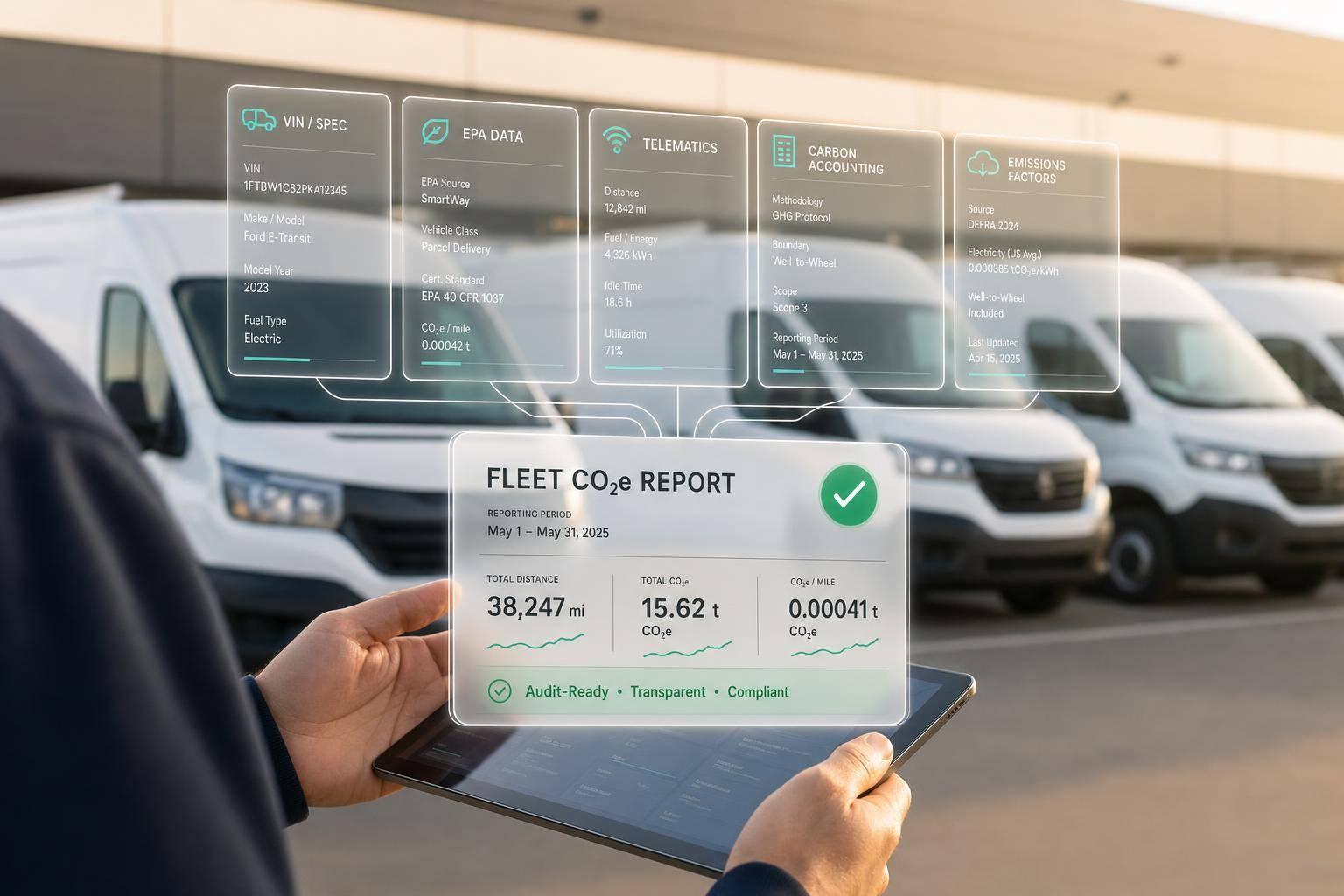
I’d sum it up like this: use VIN/spec APIs to identify the vehicle, EPA data for U.S. rated values, telematics for fuel burn and mileage from daily use, carbon accounting APIs to turn activity into CO₂e, and emissions-factor APIs to fill data gaps by country. That matters because fleets often move between g/mile and g/km, MPG and L/100 km, and EPA and WLTP results.
A few numbers show the scale of the issue:
- U.S. 2026 CO₂ targets: about 132 g/mile for passenger cars and 187 g/mile for light trucks
- EU WLTP fleet limits: 93.6 g CO₂/km for cars and 153.9 g CO₂/km for vans
- CarsXE batch support: up to 10,000 VINs per request
- CarsXE uptime claim: 99.9%
- CarsXE average response time: 120 ms
- EPA coverage: U.S. light-duty vehicles back to 1984
Here’s the short version of where each API type fits:
- Vehicle data APIs: identify fuel type, engine, weight class, and emissions standard
- Government fuel-economy APIs: supply official U.S. rated MPG and CO₂ data
- Telematics APIs: log fuel use, distance, hours, and idling from vehicles in service
- Carbon accounting APIs: convert activity data into report-ready CO₂e
- Emissions-factor APIs: apply country or framework-specific factors when direct data is missing
Fleet Emissions Compliance API Stack: From VIN to CO₂e Report
Quick Comparison
API type What I’d use it for Main limit Vehicle data VIN decoding, specs, emissions class, fleet sorting Static data only EPA FuelEconomy.gov U.S. rated MPG and tailpipe CO₂ U.S.-only, light-duty focus Telematics Daily fuel use, mileage, idling, trip records Needs hardware and provider mapping Carbon accounting CO₂e totals for reporting Depends on input quality Emissions-factor data Fill gaps with country-specific factors Mapping can get technical
Bottom line: I’d build the stack in this order: vehicle identity → rated emissions → trip/activity data → CO₂e calculation → local factor check. That gives you a clean path for audits without stuffing the process into spreadsheets.
1. CarsXE Vehicle Data APIs
This first layer cleans up VIN and spec data before the article moves into official fuel-economy ratings, telematics, and emissions factors. Vehicle data is the starting point for emissions compliance. If you want to calculate CO₂ output, place a vehicle in the right rule bucket, or flag it for a low-emission zone, you need clean, structured specs across the fleet. CarsXE supplies that base layer.
Data Scope
CarsXE's VIN decoding API returns structured fields used in emissions compliance, including fuel type, engine displacement, cylinder count, aspiration, drivetrain, transmission, curb weight, and GVWR [3]. For electrification screening, the Year Make Model API includes boolean flags like is_electric and is_plugin_electric, which lets compliance tools separate zero-emission vehicles from ICE units without a manual check [2].
The International VIN Decoder also returns an emission_standard field that maps vehicles to regional classes such as Euro 4, Euro 5, Euro 6, LEV, ULEV, or SULEV. It also includes avg_co2_emission_g_km, a standardized CO₂ value such as 174.03 g/km based on standardized test cycles [1].
Regulatory Alignment
Model year is a common compliance key, especially for U.S. phase-out timelines and EU access rules. In Europe, low-emission zone access often depends on whether a vehicle meets Euro 5 or Euro 6. Teams can screen for that using model year and fuel type, then confirm it with CarsXE's emission_standard field [1].
That means a compliance app can sort a fleet into compliant, transitional, and phase-out groups on its own using these fields. No spreadsheet wrangling. No guesswork.
Geographic Coverage
CarsXE covers vehicles from 50+ countries, including EU markets, Japan, and Latin America [5][6]. So if your fleet crosses borders, you can still decode vehicles through one integration instead of stitching together a patchwork of country-by-country tools.
CarsXE also reports 99.9% uptime and a 120 ms average response time. On top of that, it supports batch decoding of up to 10,000 VINs per request [3][4].
Compliance Workflow Fit
CarsXE fits into a fleet compliance workflow in a few key spots:
- During onboarding, each new vehicle's VIN can auto-fill fuel type, engine specs, and emission standard.
- Before regulatory audits or ESG reporting cycles, a batch call can check that the master data used for emissions inventory calculations is current.
- The OBD Codes Decoder API covers more than 3,000 OBD-II codes and translates diagnostic trouble codes into plain-language descriptions with severity ratings [7].
That last piece matters more than it may seem at first glance. If a vehicle throws P0420, the system can trigger a service alert and create a maintenance record you can point to later during an audit.
Use avg_co2_emission_g_km for regulatory screening. Pair it with telematics or fuel-card data for on-road emissions.
That master-data layer sets the baseline for the next category: government fuel-economy and emissions-rating APIs.
2. EPA FuelEconomy.gov Web Services API
The EPA FuelEconomy.gov Web Services API is the EPA/DOE source for U.S. window-sticker ratings and compliance-grade fuel-economy data. Once VIN-level data confirms the vehicle, EPA ratings give you the official U.S. benchmark. For global fleets, though, this dataset is just one piece of the puzzle, not the whole compliance picture.
Regulatory Alignment
The API groups vehicles into emission standard tiers - LEV, ULEV, and SULEV [1]. Use it when you need the U.S. statutory baseline for rated emissions and fuel economy.
Data Scope
Coverage includes U.S. light-duty cars, SUVs, and trucks going back to 1984 [8]. For each vehicle, the API returns:
- City, highway, and combined MPG
- Tailpipe CO₂ in grams per mile
- Annual petroleum use
- Fuel type
- Engine specs, including cylinders and displacement
If you're reporting outside the U.S., you'll need to convert g/mile to g/km.
Geographic Coverage
Coverage is U.S.-only and does not support Euro 6 or other non-U.S. standards [8]. So while it's a solid baseline source, it doesn't give you a full compliance stack.
Compliance Workflow Fit
The EPA API works best as a rated baseline, not a live feed. It shows what a vehicle is rated to emit under standardized test conditions, which makes it useful for sustainability reporting and emissions calculations. It also returns annual fuel-cost estimates [8].
The limits are pretty clear. It only covers U.S. light-duty ratings, so heavy-duty fleets, international reporting, and live consumption data call for other API layers. For live fuel use and cross-border fleets, the next layer is telematics.
3. Commercial Telematics Fleet APIs
The EPA API gives you a rated starting point. Telematics APIs show what happens on the road. They pull live data from installed hardware such as CAN-bus sensors, OBD devices, and onboard telematics units. That means they can log fuel use, trip distance, operating hours, and AdBlue use as those events happen [9].
So the issue isn't only what a vehicle is supposed to do on paper. It's what it actually does in daily use.
Regulatory Alignment
Raw telematics data isn't compliance-ready on its own. To use it for reporting, you need to map that data to a recognized emissions method. That step turns fuel use and operating hours into auditable CO₂ and NOx figures.
Frameworks like EMEP/EEA for road transport do exactly that. They translate those inputs into values that match permit and audit needs [9].
Data Scope
Telematics records actual performance data in a way specification-based APIs can't. When you pair it with VIN data, you close the gap between rated specs and real use [9].
Geographic Coverage
Coverage follows wherever the fleet operates, so reporting still depends on local rules. Using recognized international methods helps keep cross-border reporting auditable [9].
Automated workflows can also group metrics by:
- Project location
- Time period
- Reporting need
That makes telematics useful for Scope 3 reporting and nitrogen dossier work [9].
Compliance Workflow Fit
Telematics APIs support active, ongoing monitoring. Teams can keep these metrics for audits, which makes them useful for long-term compliance reviews [9].
This matters more now because tenders and permit applications more often ask for auditable emissions data tied to actual operating hours and fuel use. Telematics is the layer that supplies that record. That record then feeds carbon accounting APIs, which convert fleet activity into inventory-grade emissions reporting.
sbb-itb-9525efd
4. Carbon Accounting APIs for Vehicle Emissions
Once you have activity data, carbon accounting APIs turn it into reportable CO₂e. They use recognized calculation methods on inputs such as fuel type, distance, and fuel-use data, then return figures that can move straight into compliance and ESG reporting workflows.
Regulatory Alignment
Carbon accounting numbers only matter if they match the right reporting standard. Use vehicle-class data from VIN records to map each vehicle to the right jurisdiction before you calculate CO₂e. That step keeps every result tied to the correct jurisdictional standard, which makes the output usable for cross-border compliance reporting.
Data Scope
CO₂e accuracy starts with input quality. At a minimum, you need fuel type, distance, and fuel-use data. APIs that return WLTP-rated and EPA-rated fuel-economy data give you a standardized baseline for carbon accounting. Vehicle classification from VIN records also supports Scope 3 reporting when paired with those consumption inputs [1][10].
Geographic Coverage
For U.S.-based fleets with vehicles operating abroad, the hard part is normalizing data across different testing standards. A VIN decoder that supports international manufacturers can translate regional specs into universal metrics like g/km, which helps keep GHG Protocol reporting consistent across the full inventory [1].
Compliance Workflow Fit
Structured JSON can flow right into ESG and reporting systems without manual data entry. And when activity data is missing, emissions-factor APIs can fill those gaps.
5. National and Global Emissions Factor Data APIs
When carbon accounting runs into missing activity data, emissions-factor APIs help close the gap with jurisdiction-specific defaults. They provide the CO₂e inputs that carbon accounting depends on.
The big split comes down to scope. National APIs are built around local rules and reporting standards. Global APIs pull data from more than 150 countries through a single request [11].
Regulatory Alignment
A national API should line up with the emissions standard and pollutant limits used in that jurisdiction. If a fleet operates in more than one country, use the API that matches the reporting jurisdiction.
Data Scope
Good emissions-factor APIs do more than return a single CO₂ number. They should include fuel type, engine configuration, and standardized g/km values. It also helps to have VIN-level fields such as fuel type, engine configuration, and standardized g/km values [1].
That kind of detail makes VIN-level benchmarking possible and supports year-over-year reporting without turning the process into guesswork.
Geographic Coverage
National-focused APIs usually cover North America, including the U.S., Canada, and Mexico [3]. Global aggregators go much farther, with coverage across more than 150 countries, including Europe, China, Japan, and the Middle East [11].
For international fleets, that broader reach makes cross-border reporting and lifecycle tracking much easier.
Compliance Workflow Fit
Structured API responses with fields like emission_standard and avg_co2_emission_g_km can plug straight into carbon accounting and sustainability reporting workflows [1]. For large fleets, batch support matters too. APIs that can process up to 10,000 VINs per request make emissions audits far more practical at scale [4].
That’s why emissions-factor APIs sit between raw vehicle data and audit-ready CO₂e reporting.
Strengths and Tradeoffs Across API Categories
Each API layer handles a different part of the compliance workload. The table below shows where each one fits in the stack.
API Category Main Strengths Key Limitations Best Use Case CarsXE Vehicle Data International VIN/plate decoding; regional standards such as Euro 4/5/6, LEV, ULEV, and SULEV; average CO₂ in g/km; batch decoding up to 10,000 VINs per request [1][3] Static data; does not reflect real-world driving behavior or actual fuel burn Cross-border vehicle identification and diagnostics EPA FuelEconomy.gov Free, authoritative U.S. government ratings for light-duty vehicles U.S. market only; no heavy-duty or international vehicle coverage U.S. fuel-economy verification Commercial Telematics Live fuel-use, idling time, and distance data from actual operations Requires hardware installation; data formats vary by provider Real-time fuel tracking and driver behavior analysis Carbon Accounting Converts activity data into standardized CO₂e outputs; handles GWP calculations for ESG reporting Output accuracy depends on the quality of upstream input data Corporate sustainability and ESG disclosures Emissions Factor Regional emissions factors aligned with frameworks like DEFRA and IPCC; supports global benchmarking Requires technical expertise to map factors to specific vehicle types and jurisdictions Regional emissions-factor conversion and benchmarking
The main split here is simple: static vehicle data vs. live operating data.
CarsXE gives you the VIN-level starting point. It tells you what the vehicle is, how it’s classified, and which standards apply. Telematics picks up from there and shows what happened in day-to-day use - fuel burned, distance traveled, idling time, and route-level activity.
After that, the workflow tends to move in a short chain. Operational data goes into carbon accounting tools for CO₂e conversion. Then emissions-factor APIs help apply the right jurisdictional values. Think of it like passing the baton: one system identifies the vehicle, another tracks usage, and another turns that usage into reportable emissions data.
In most organizations, these layers don’t sit with one team. Fleet ops often owns vehicle data. IT usually handles telematics. Sustainability or finance takes over once the focus shifts to carbon outputs. That handoff is where things can get messy. If records don’t line up cleanly, you end up with gaps, mismatched entries, or duplicate vehicles showing up in reports.
Conclusion
After comparing the layers, the right choice comes down to matching each API to the job it needs to do. No single API handles every compliance layer. You need one for vehicle identity, one for rated emissions, one for live usage, and one for CO₂e conversion.
That chain - VIN/specs → rated emissions → live activity → CO₂e conversion → jurisdiction-specific factors - is the core flow behind any auditable compliance stack.
Fit the stack to your fleet’s geography and reporting needs. The goal is simple: pick the smallest stack that still covers identity, ratings, activity, and reporting.
Scenario Primary API Layers Key Priority U.S. domestic fleet Vehicle identity/specs + EPA FuelEconomy.gov + telematics Regulatory alignment with EPA ratings Multinational fleet CarsXE International VIN Decoder + regional emissions factor APIs Cross-border VIN coverage and consistent spec data ESG reporting Telematics + carbon accounting APIs + emissions factor APIs CO₂e accuracy and audit-ready documentation
Once you’ve checked fit, compare pricing. Cost matters. But coverage and use-case fit matter first.
EPA FuelEconomy.gov is free for U.S. light-duty ratings. CarsXE offers a free Sandbox and paid production tiers.
Choose regulatory fit and data completeness first. A weak VIN match or the wrong emissions factor can throw off ESG and compliance output fast.
FAQs
Why isn’t one API enough for global fleet emissions?
Managing global fleet emissions is messy because there isn't one rulebook that applies everywhere. Different regions set different limits for pollutants like nitrogen oxides and carbon monoxide.
And once vehicles start crossing borders and state lines, things get even more complicated. A fleet may run into different testing methods, performance benchmarks, and legal rules depending on where a vehicle is registered.
That also means a single data source won't give you the whole picture. It can't fully account for regional rule changes, recall history, and shifting emissions requirements.
When should I use rated emissions versus telematics data?
Use rated emissions as the baseline for a vehicle’s compliance status, regulatory category, and standardized performance. Those figures come from the manufacturer’s official specs, which is why they’re the right fit for registration records, tax treatment, resale value, and past compliance checks.
Use telematics and OBD data for what’s happening right now. That includes active diagnostic trouble codes, current emission control system status, and other live signals that matter during inspections or maintenance work.
In short: rated data is for registration and compliance categorization; telematics and OBD data is for maintenance and live performance tracking.
How do I handle EPA, WLTP, g/mile, and g/km in one workflow?
Use one standard unit in your backend, then convert only when you need to show the data in reports. CarsXE can give you normalized vehicle emissions data, usually in g/km, and that works well as the single input for your system.
From there, add a simple conversion layer for g/mile and format the output for U.S. reporting. That gives you one workflow for handling EPA, WLTP, and unit differences without turning the whole process into a mess.
Related Blog Posts
- Ultimate Guide to Emission Compliance APIs
- Global Emission Standards: Compliance Guide
- Global Emission Standards: What Developers Should Know
- Top APIs for Emission Data Integration