Top Use Cases for Live Vehicle Data APIs

Top Use Cases for Live Vehicle Data APIs
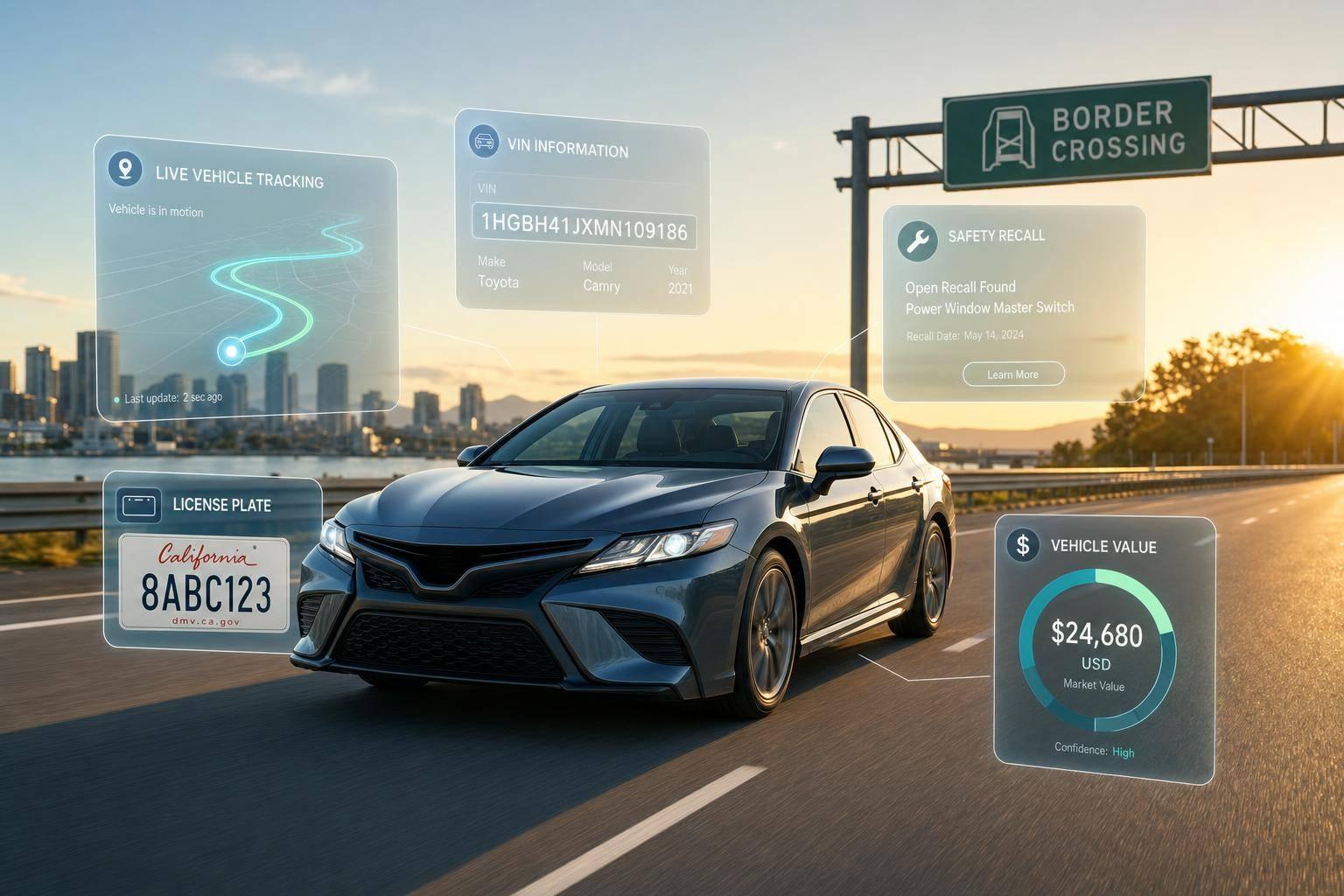
Live vehicle data is most useful when you pair it with VIN, plate, recall, history, and value data. That mix helps you price insurance, route fleets, spot faults, handle claims, track compliance, and match vehicles across countries.
If I had to boil this article down, it comes to four main use cases:
- Insurance: use mileage, driving events, and crash signals for UBI, risk scoring, FNOL, and claims review
- Fleet management: use GPS, idle data, mileage, engine hours, and fault codes for dispatch, maintenance, and fuel control
- Safety and compliance: use speeding, harsh events, HOS/ELD logs, and state-mile records for driver scoring, audits, and tax reporting
- Multi-country platforms: match live events to the right vehicle record with VIN and plate data, then attach specs, recalls, history, value, and images
A few numbers stand out:
- 21 million+ U.S. policyholders shared telematics data with insurers in 2024
- U.S. vehicles waste 6 billion+ gallons of fuel per year from idling
- Driver coaching with telematics cut harsh events by 56%–63%
- IFTA records may need to be kept for 4 years, while HOS records are kept for 6 months
Live Vehicle Data API Use Cases: Key Stats & Comparisons
How to start working with Connected Car Data?
sbb-itb-9525efd
Quick Comparison
Use Case Main Live Data Main Reference Data What You Get Insurance Mileage, braking, speeding, crash events, OBD VIN, specs, history, recalls, market value Better pricing, faster claims, fraud checks Fleet GPS, ignition, idle time, odometer, engine hours, DTCs Specs, recalls, OBD code definitions Better routing, less fuel waste, fewer breakdowns Safety & compliance Speed, cornering, braking, HOS/ELD logs, state mileage VIN, recalls, service context Driver scoring, audit logs, fuel-tax records Multi-country products Any live event feed VIN decode, plate lookup, specs, value, images One clean vehicle record across markets
If you work with connected vehicles, the takeaway is simple: live signals show what a vehicle is doing now, and reference data shows what that vehicle is. You need both to build workflows that act on data instead of just displaying it.
1. Insurance Pricing, Risk Scoring, and Claims Triage
Insurance is one of the highest-value use cases for live vehicle data. In 2024, more than 21 million U.S. policyholders shared telematics data with their insurer, which reflects a 28% compound annual growth rate since 2018.[8] That makes insurance the clearest proving ground for live data because it touches pricing, risk, and claims as events happen.
Usage-Based Insurance and Driver Behavior Models
Usage-based insurance, or UBI, relies on live signals like mileage, speeding, harsh braking, rapid acceleration, cornering, time of day, and phone use. Those signals come from smartphones or in-vehicle devices and flow into risk models.[3][4]
In the United States, most UBI programs still use discount-only pricing. The insurer sets the base premium with standard methods, then uses telematics data to decide how much of a discount the driver gets instead of adding penalties.[9] That setup tends to reduce pushback from both regulators and drivers. Progressive helped set the pace here by tracking miles driven, time of day, and hard braking.[9]
Static vehicle data also helps tighten underwriting. A VIN decode confirms the exact vehicle setup, including trim, safety features, and engine, so the policy lines up with the actual car. If the policyholder does not provide a VIN at the start, a plate-to-VIN lookup through CarsXE can fill in the missing detail right away, without the usual back-and-forth.[7]
Crash Alerts and Faster Claims Intake
When a major impact happens, high-frequency accelerometer and gyroscope data, combined with GPS, can estimate impact severity and trigger FNOL automatically.[3][4] That means a draft claim can be created with the time, location, and vehicle details already filled in. In more serious cases, the event can be routed straight to an adjuster.
Static data from CarsXE adds another layer of context for triage. Vehicle history can show prior accidents and title issues that affect the car’s condition before the loss. Recall data can show whether an unresolved safety defect may have played a role. Market value data helps adjusters make a faster, more defensible call on repair versus total loss.[2][5][6]
The same inputs can also support fraud review and move settlements along faster, which makes this data model useful across the full claims process.
Insurance Data Inputs and Business Uses: Comparison Table
Data Type Pricing Underwriting Fraud Review Claims Triage Trip Data / Mileage Enables pay-per-mile models Validates annual usage estimates Detects location and usage inconsistencies Confirms exact time and place of incident Driving Events Adjusts discounts for safe behavior Identifies high-risk operators Detects staged-crash patterns Reconstructs impact severity and impact pattern Diagnostics (OBD) Supports maintenance-based risk tiers Assesses vehicle health at policy start Identifies pre-existing mechanical issues Provides post-crash health and fault data VIN / Specs Factors in safety-feature discounts Matches policy to exact vehicle configuration Verifies vehicle identity Determines correct OEM parts for repairs Vehicle History - Flags salvage, theft, or title issues Catches undisclosed damage and prior-loss inconsistencies Adds prior repair and recall context (CarsXE) Market Value Sets appropriate coverage limits Prevents over-insurance at policy start Detects over-valuation in total loss claims Speeds total-loss settlement
The same live signals that help price risk can also cut downtime in fleet operations.
2. Fleet Operations, Maintenance, and Compliance
Fleet managers lean on live data to cut deadhead miles, wasted fuel from idling, and surprise downtime. In practice, that work usually falls into three connected jobs: dispatch, maintenance, and compliance reporting.
Dispatch, Geofencing, and Cost Control
Real-time GPS, plus location and ignition data, helps dispatchers send the closest open vehicle to a job site. Route history adds another layer. It shows detours, extra stops, and route drift, which is a big deal for service fleets that bill by the hour and for delivery teams working inside tight delivery windows.
Geofencing makes that process easier to track. A virtual boundary around a depot, customer site, or restricted area can trigger automatic entry, exit, and idle alerts. The moment a vehicle crosses the boundary, or sits too long inside it, the system sends a notice. That means dispatch can confirm arrival without a call or text, and a yard supervisor can get alerted if a truck moves after hours.
Idle time is one of the plainest ways to cut costs. The U.S. Department of Energy estimates that American road vehicles waste more than 6 billion gallons of fuel per year just idling, with a typical vehicle burning about 1 gallon per idle hour.[12] That adds up fast. Live idle alerts, paired with driver coaching, give fleet managers a direct way to bring that number down.
Once dispatch is handled in real time, the next place to save money is idle time and surprise maintenance.
Predictive Maintenance from Diagnostics and Mileage Data
Fixed-interval oil changes and tire rotations are a decent baseline, but they don't reflect what each vehicle is actually dealing with on the road. Live OBD and sensor data help fill that gap by flagging trouble before it turns into a roadside breakdown. The main signals here are DTCs, voltage, coolant temperature, tire pressure, odometer, and engine hours.
DTCs show that a fault has already been detected. Voltage and temperature trends can point to battery or cooling problems days before the vehicle fails. Predictive models can also flag turbocharger, DPF, or EGR failures 2 to 4 weeks in advance by combining J1939 fault codes with mileage, idle time, and engine hours.[11] That's enough lead time to schedule a repair during a planned service stop instead of dealing with a breakdown in the middle of a route.
After location tracking, live diagnostics add the next layer of cost control. CarsXE supports that workflow directly. Its OBD code decoder turns raw fault codes into plain-language descriptions, so a fleet manager doesn't have to dig through a repair manual to figure out what a code means or how urgent it is. When that is paired with CarsXE's vehicle specifications and recall data, it becomes easier to see whether a fault is tied to a known safety issue and move that repair higher in the queue.[1][10]
Fleet Workflows and Required Live Data: Comparison Table
The same live feed can support dispatch, maintenance, and reporting at the same time.
Fleet Workflow Required Signals Operational Outcome Common U.S. Reporting Units Dispatching Real-time GPS, ignition state, vehicle availability Faster job assignment, reduced deadhead miles Miles, minutes, timestamps Geofencing Latitude/longitude, entry/exit events Arrival confirmation, unauthorized-use detection Miles, feet, timestamps Preventive Maintenance DTCs, odometer, engine hours, battery voltage, coolant temp °F Fewer breakdowns, condition-based service scheduling Miles, hours, volts, °F, USD DOT Compliance Recall status, VIN specs, brake/tire sensor data Passed roadside inspections, audit-ready safety records Pass/Fail, date Hours-of-Service Logging Engine on/off events, odometer, GPS history Route verification, stronger audit support Miles, engine hours IFTA Reporting State-line GPS crossings, mileage by jurisdiction Accurate multi-state fuel-tax filing Miles, gallons
Those same signals also support safety scoring and audit-ready compliance reporting.
3. Safety Monitoring, Regulatory Reporting, and Public-Sector Analytics
Live vehicle data does more than show where a car or truck is right now. It also supports safety scoring, audit-ready reporting, and public-sector analysis.
Driver Safety Scoring and Incident Prevention
Live telemetry turns day-to-day driving into real-time safety scores. These scores usually track harsh braking, rapid acceleration, hard cornering, speeding, and phone use. Many cloud platforms combine those signals into a 0–100 score or place drivers into risk tiers.
The scoring model matters. Events should be weighted by severity and road type. For example, driving 20+ mph over the speed limit on a highway should count more than slight overspeeding in city traffic. That simple change makes the score much closer to what safety teams care about in practice.
Scores by themselves don't change behavior. Coaching is what turns them into action. A study of Class 8 truck drivers found that telematics paired with coaching cut harsh braking and sudden acceleration events by 56%–63% and speeding by 33%.[21] PepsiCo Turkey's BETTER DRIVE program used a score based on speeding (50% of score), seat belt use (20%), and harsh maneuvers (30%). The result was a 93% reduction in high-risk drivers and a 70% reduction in collisions across a 600-vehicle fleet.[20]
Route-level patterns add another signal. If harsh braking keeps showing up at the same intersection or delivery zone, that points to a place-based risk, not just a driver issue. Safety teams can then re-route vehicles, adjust schedules, or focus training on that location.
Vehicle data makes this process sharper. CarsXE can help safety teams separate true driver risk from mechanical trouble by checking OBD fault codes and recall data when a safety score jumps after abnormal braking.[1][10]
The same events that point to unsafe driving also create a record that insurers and regulators can review later.
Compliance and Audit-Ready Reporting
ELDs must record date, time, GPS location, engine hours, vehicle miles, driver/user ID, vehicle ID, and motor carrier ID.[13][14][15] Motor carriers must keep RODS for six months, with backup copies stored separately.[16]
IFTA fuel tax reporting adds more recordkeeping. Fleets need auditable mileage by state for each reporting quarter. Some state guidance also calls for GPS records at least every 10 minutes while the engine is running. Those records must include latitude and longitude to at least 4 decimal places, timestamps, and odometer readings. They must be kept for four years and be exportable as CSV or spreadsheet files.[17] CarsXE helps connect live mileage with VIN-based service intervals, recalls, and repair history.[1]
Cross-border fleets have another challenge: privacy and retention rules don't line up neatly from one market to another. U.S. FMCSA rules differ from data protection norms elsewhere. A practical setup is to start with a global baseline: collect only the data you need, be clear with drivers about what is being tracked, and keep security tight. Then apply local rules on top of that, such as shorter raw location retention where privacy laws are stricter, while keeping aggregated compliance logs where allowed.
At fleet scale, those same logs can also help public agencies study road risk across full regions.
Safety and Compliance Use Cases by Stakeholder: Comparison Table
Stakeholder Live Signals Used Reporting Purpose Expected Business Outcome Fleet managers Speed, harsh braking/acceleration, cornering, GPS, HOS/ELD status, OBD fault codes, odometer Driver safety scoring, HOS compliance, route risk analysis Fewer crashes, lower premiums, reduced costs Insurers Speed vs. posted limits, braking, phone use, mileage, trip context, claim-linked diagnostics Usage-based pricing, fraud detection, claim triage Accurate pricing, lower loss ratios, faster claims Repair networks OBD-II fault codes, mileage, service history, VIN, recall data Warranty validation, proactive maintenance recommendations Higher shop utilization, fewer repeat failures Regulatory/public-sector teams Aggregated speed, harsh events, GPS traces, crash timestamps, roadway metadata Roadway risk analysis, infrastructure planning, policy impact evaluation Safer roads, better-targeted enforcement
Public-sector agencies are also using aggregated, anonymized telematics data to find risky corridors. Washington State overlaid five years of injury crashes with speeding risk to guide enforcement.[18] In Washington, D.C., near-miss telematics events showed risk patterns that crash data alone did not catch.[19]
For global fleets, live safety and compliance data becomes more useful when it is matched with VIN and plate context across markets.
4. Multi-Country Vehicle Platforms and Product Integration
Combining Live Telemetry with VIN, Plate, and Vehicle Reference Data
For global fleets and insurers, the next job is simple to describe but hard to get right: match every live event to the correct vehicle in every market.
That’s the core issue with multi-country products. If a live signal points to the wrong vehicle record, everything downstream starts to wobble. Onboarding gets messy. Reporting turns unreliable. Cross-border product matching falls apart.
A clean way to handle this is to build the workflow in layers. First, ingest live signals. Next, resolve vehicle identity. Then attach reference data.
Decode the VIN to get make, model, year, trim, and engine specs. If a VIN isn’t available, run a plate lookup instead. Once you’ve tied the event to a single vehicle record, you can attach the rest of the data the workflow needs, like recall status, market value, history, and images.
After identity is resolved, country-specific rules become the next layer. Normalize by country so VIN and plate lookups return one consistent vehicle record across markets. The same vehicle may be identified in different ways depending on the country, so consistency is what makes the integration dependable.
For teams building multi-country platforms, CarsXE supports this directly with an International VIN Decoder for non-U.S. VINs, a separate U.S. specifications endpoint, and license plate decoding that uses country codes to return consistent vehicle records across 50+ countries.
Use telematics for live signals, and use a reference API for specs, recalls, valuation, and history. Cache the reference layer and refresh it on a schedule. That split makes the enrichment layer easier to cache, refresh, and reuse across products.
Enrichment Layer Data Fields When to Fetch Identity resolution VIN decode, plate lookup, make/model/year/trim At vehicle onboarding or first event Safety context Recall status, OBD fault codes On diagnostic alert or scheduled check Financial context Market value (retail, wholesale, trade-in), vehicle history For pricing, underwriting, or resale workflows Visual verification Vehicle images In consumer-facing apps or inspection flows
Conclusion: The Highest-Value Use Cases to Prioritize First
Across every use case, live signals matter most when they’re paired with trusted vehicle context. Insurance, fleet, safety, and compliance workflows all rely on the same base: live data plus normalized vehicle identity.
A good place to start is one workflow at a time. Map the exact fields it needs, then connect normalized reference data so the system can act automatically.
FAQs
What live vehicle data should I start with?
Start by figuring out which workflows you want to simplify first. For many developers, the International VIN Decoder is a smart place to begin. A 17-character VIN can quickly confirm key vehicle details such as make, model, year, and specs.
After VIN decoding is up and running, you can layer in the Market Value API, Vehicle History API, or Plate Decoder based on what your app needs. CarsXE also includes a free Sandbox tier with up to 100 free API calls for testing.
Why do I need VIN or plate data with telematics?
VIN or plate data ties telematics to the exact vehicle, not just a driver or device. That matters because it gives teams a cleaner view of diagnostics, risk, and safety.
It also connects raw telematics data to things like vehicle specs, recall history, and market value. In plain terms, the data starts to mean more once you know the precise car, truck, or van behind it.
That leads to more accurate warranty reviews, fraud detection, and claims processing. It also supports compliance and helps teams stay ahead of maintenance needs across different model years.
How can live vehicle data APIs improve compliance?
Live vehicle data APIs make compliance easier by automating how teams track safety and regulatory requirements. With real-time data, businesses can stay in sync with recall records and keep up with standards such as NHTSA mandates and GDPR.
They also support automated VIN-based checks for dealership inventory and fleet vehicles. That helps teams spot open safety risks before a sale or during day-to-day use, while also giving them standardized data for audit trails and documentation.
Related Blog Posts
- Vehicle History API: Common Questions Answered
- How Real-Time VIN Decoding APIs Work
- How VIN Decoding Changed Automotive Data Access
- Best APIs for Autonomous Vehicle Data