Real-Time OBD Threat Detection: AI's Role

Real-Time OBD Threat Detection: AI's Role
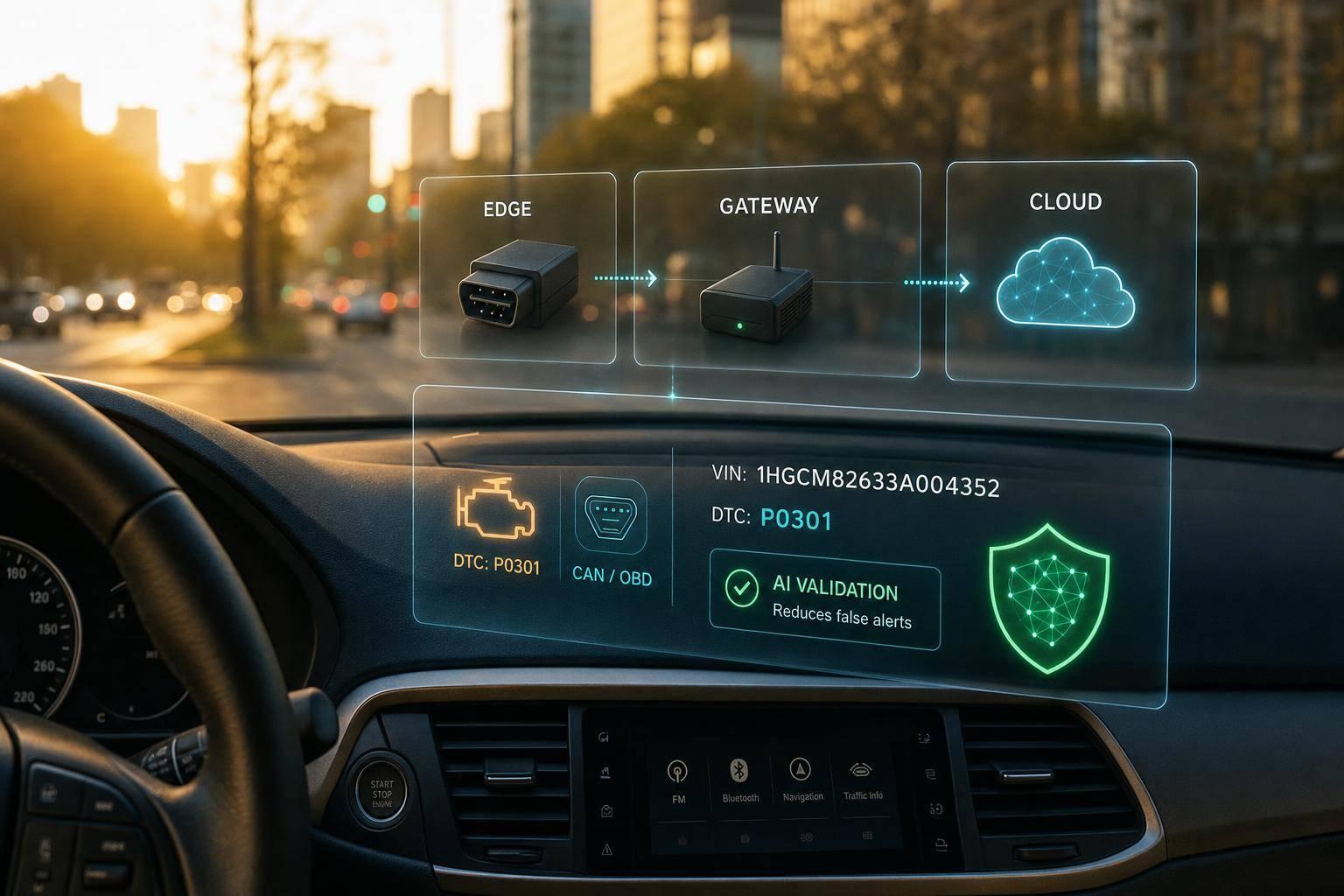
If you wait to review OBD and CAN data later, you can miss an attack that happens in seconds. My take is simple: the best setup uses AI to spot odd traffic as it happens, splits work across edge, gateway, and cloud layers, and adds vehicle context so alerts make sense.
Here’s the short version:
- OBD-II is no longer just a service port. Dongles, telematics gear, and apps add more paths into vehicle data.
- Attack traffic can look like normal diagnostics, which makes fixed rules easy to bypass.
- Modern vehicles can produce up to 25 GB of data per hour, and connected platforms can process more than 50,000 messages per second.
- AI helps by learning what normal traffic looks like, then flagging behavior that drifts from that pattern.
- The model alone is not enough. You also need the right deployment layer, clean data, secure transport, and regular retraining.
- Vehicle context matters. A code or sensor reading means more when tied to the VIN, model year, make, and engine setup.
For me, the main lesson is this: fast detection is only half the job. You also need alerts that explain what happened, which vehicle it affects, and whether it lines up with a known fault or recall.
A simple way to think about the stack:
Layer Main job Best use Edge Immediate checks inside or near the vehicle Low-latency screening Gateway Mid-layer analysis Better scoring with modest delay Cloud Deep fleet-level review Cross-vehicle patterns and heavier models
I’d sum it up like this: use AI for anomaly detection, keep the first pass close to the vehicle, send richer events upstream, and enrich alerts with decoded DTCs, VIN data, specs, and recall checks. That gives U.S. teams a setup that is fast enough to react and clear enough to act on.
I Built an AI-Powered OBD2 Diagnostic System
sbb-itb-9525efd
The Problem: Why OBD Threats Are Hard to Detect
OBD threat detection sounds straightforward at first. Then you look at the scale.
A modern connected vehicle can generate up to 25 GB of data per hour from its internal sensors and systems [4]. On top of that, production-level connected vehicle platforms can handle more than 50,000 messages per second across a fleet [4]. That creates the first big issue: suspicious activity can disappear inside normal diagnostic traffic.
Common Attack Patterns on OBD and CAN Traffic
The toughest attacks don’t stand out. They blend in.
Malicious traffic can look a lot like routine diagnostics. And blended attacks are even harder to spot because they may resemble normal diagnostic spikes. That makes the signal messy. What looks harmless at a glance may not be harmless at all.
Where Rule-Based Security Falls Short
This is where fixed defenses start to crack. Static rules only work well when behavior stays predictable. OBD traffic doesn’t.
Rule-based systems rely on pre-defined signatures and thresholds. So if an attack doesn’t match something the system already knows, it can slip through. That includes zero-day attacks.
There’s another problem too: the vehicle landscape is all over the map. Modern diagnostic datasets contain more than 3,000 distinct OBD codes [1], and manufacturers often add proprietary extensions to OBD-II [4]. Normal traffic changes based on the vehicle type and its setup. In plain English, what looks normal for one car may look odd for another.
That mismatch leads to two bad outcomes:
- New attack patterns get missed
- Legitimate activity gets flagged as suspicious
And once security teams stop trusting alerts, response slows down fast. At that point, even good warnings can get ignored.
Operational Constraints in U.S. Connected Vehicle Environments
Even if the detection logic is solid, deployment limits still matter. In-vehicle edge devices have tight CPU and memory budgets, which puts many heavy models out of reach. That’s why many setups split detection between the vehicle edge and the cloud [4].
Both sides also need secure transport through TLS. Otherwise, the monitoring channel itself can turn into an attack surface.
The Solution: How AI Improves Real-Time OBD Threat Detection
AI gives human teams a way to watch OBD and CAN traffic at a scale people simply can’t handle on their own. Instead of trying to inspect every signal by hand, machine learning studies what normal traffic looks like and flags activity that drifts from that pattern in real time. The idea is pretty straightforward: teach the system normal behavior first, then catch anomalies the moment they show up.
Using AI to Learn Normal Vehicle Communication
AI models build a baseline from normal OBD-II and CAN communication patterns, which makes small but important deviations easier to spot as they happen. For that baseline to hold up, the training data needs to cover different vehicle classes, including motorcycles, trucks, and RVs [1]. Once that baseline is in place, the next decision is where to deploy the model, because that affects how fast it can respond.
Which AI Models Fit Real-Time Detection
The right model depends on a few practical limits: latency, memory, and how often the system needs updates. Edge models need to stay lightweight. Gateway models have to balance speed with detection quality. Cloud models can take on deeper analysis when latency isn’t a dealbreaker.
In plain terms, each layer does a different job:
- Edge handles fast, local checks with tight hardware limits.
- Gateways sit in the middle, trading a bit of speed for better analysis.
- Cloud systems take on heavier inspection when extra delay is acceptable.
Those limits shape where each model fits in the detection stack.
How AI Cuts False Positives Without Missing New Threats
Too many alerts make a detection system hard to use. AI helps by relying on anomaly-based detection, which looks for behavior that breaks from the baseline instead of only hunting for known signatures. That matters because new threats don’t always match old attack patterns.
Two things help keep detection steady over time. First, narrowing the pipeline to high-value signals cuts noise before it ever reaches the model. Second, regular retraining keeps the system current as traffic patterns change. On top of that, structured diagnostic data across more than 3,000 trouble codes [1] gives the model better context, helping it tell the difference between normal variation and suspicious behavior. That improves both anomaly scoring and false-positive control.
That deployment choice leads directly to the stack design.
Implementation: Building an AI-Driven OBD Detection Stack
AI-Driven OBD Threat Detection: Edge vs Gateway vs Cloud
Early architecture choices shape detection performance in the field. The main decision comes down to one thing: where the detection logic runs.
Edge, Gateway, and Cloud Deployment Patterns
The next step is to map each signal to the right layer.
Deployment Pattern Latency Compute Load Fleet Visibility Onboard IDS (Edge) Ultra-low High (on-vehicle) Low (single vehicle) OBD Dongle / Gateway Low Moderate Medium (local fleet) Cloud-Based Detection Higher Low (on-vehicle) High (global fleet)
That decision also affects data flow. Some data stays in the vehicle. Some gets sent up for extra context and scoring in the cloud. If you need a fast first pass, mobile apps can handle it on-device to keep latency low [8].
What Data the Detection Pipeline Should Use
The pipeline should pull from sensor values, DTCs, and VIN context.
Start with OBD-II Modes 01–09 for live readings like:
- Engine coolant temperature
- Vehicle speed
- RPM
- Throttle position
Then add Diagnostic Trouble Codes as discrete events. Raw codes are useful, but plain-language faults are easier to score and act on, so translate DTCs before scoring [6]. Each reading should also be tied back to the vehicle's VIN, model year, make, and engine configuration [3] [5].
Where CarsXE Fits in the Workflow
Raw OBD data by itself doesn't tell the model if a reading is normal for that exact vehicle. A high RPM reading on one car may be routine on another. That's where structured vehicle data comes in.
CarsXE sits in the enrichment layer. Its specs and VIN decoding features help set vehicle-level baselines, while obd_codes_decoder converts raw DTCs into fault strings the model can use for alert scoring [3] [5] [6]. The recalls API adds another check: it shows whether an anomaly lines up with a known safety defect [7].
That means the model isn't judging a code in a vacuum. It's scoring alerts with context tied to the vehicle itself.
CarsXE Endpoint Role in the Detection Workflow obd_codes_decoder Translates raw DTCs into diagnostic strings for AI alert scoring [6] specs Provides VIN-specific baselines for sensor data interpretation [3] recalls Checks whether a detected anomaly matches a known safety defect [7]
Use the sandbox to test parsing and field mapping before production [2].
Conclusion: What Teams Should Prioritize Next
Once the stack is in place, the next job is simple to say and harder to do: keep detection fast, accurate, and easy to maintain.
Real-time OBD threat detection is a balancing act. You need accuracy, low latency, and a setup your team can keep running without constant friction. AI helps by flagging odd vehicle traffic that fixed rules can miss, which makes it a strong fit for production detection at a scale manual review just can't handle.
Still, the model alone won't carry the system. Deployment architecture, data quality, and day-to-day upkeep matter just as much. The practical path is to start with a clear deployment layer, map the data pipeline, and then add enrichment so alerts include vehicle context instead of showing up as isolated signals.
In plain terms, the detection stack needs to do more than score traffic. It needs to explain what that traffic means. A modular pipeline can pair OBD decoding with vehicle-context lookups [10]. CarsXE's OBD Codes Decoder turns raw codes into actionable signals [6][9], so detections lead to decisions instead of more noise.
It also helps to treat detection like a living system, not a one-time build. Fleets change. Attack patterns change. Detection logic has to change with them. If the architecture and data layer are set up well from the start, teams don't have to choose between speed, accuracy, and upkeep. The strongest systems keep pace with both the fleet and the threat surface.
FAQs
How fast can AI detect an OBD attack?
AI-driven systems can spot potential OBD threats in real time, flagging risks the moment they show up.
Tasks that may take as long as 15 minutes by hand can be handled in seconds with API-based tools. These tools read diagnostic codes fast, which helps teams respond sooner when performance issues appear.
What data does AI need to score OBD threats?
AI needs real-time vehicle diagnostic data and access to diagnostic trouble codes (DTCs) to score OBD threats.
With a library of more than 3,000 OBD codes, it can match each code to a vehicle diagnosis and spot faults in the engine, fuel, and emissions systems. CarsXE’s OBD Codes Decoder API turns raw codes into clear descriptions, which makes threat scoring faster and more accurate.
Why isn’t rule-based OBD monitoring enough?
Rule-based monitoring falls short for modern OBD threat detection because it relies on preset logic. That works for known patterns, but it struggles when security risks shift or show up in new ways.
In real-time use, static rules can miss subtle or emerging anomalies in diagnostic data. AI-driven monitoring spots patterns with more precision, handles large data volumes more smoothly, and helps teams detect threats faster and with better accuracy.
Related Blog Posts
- How OBD Data Powers Predictive Analytics
- Phishing in OBD Systems: Case Studies
- How OBD Data Behavior Detects Cyber Threats
- Checklist for Securing OBD Data Transmission