Regional Vehicle Trends: Hot vs. Cold Climates

Regional Vehicle Trends: Hot vs. Cold Climates
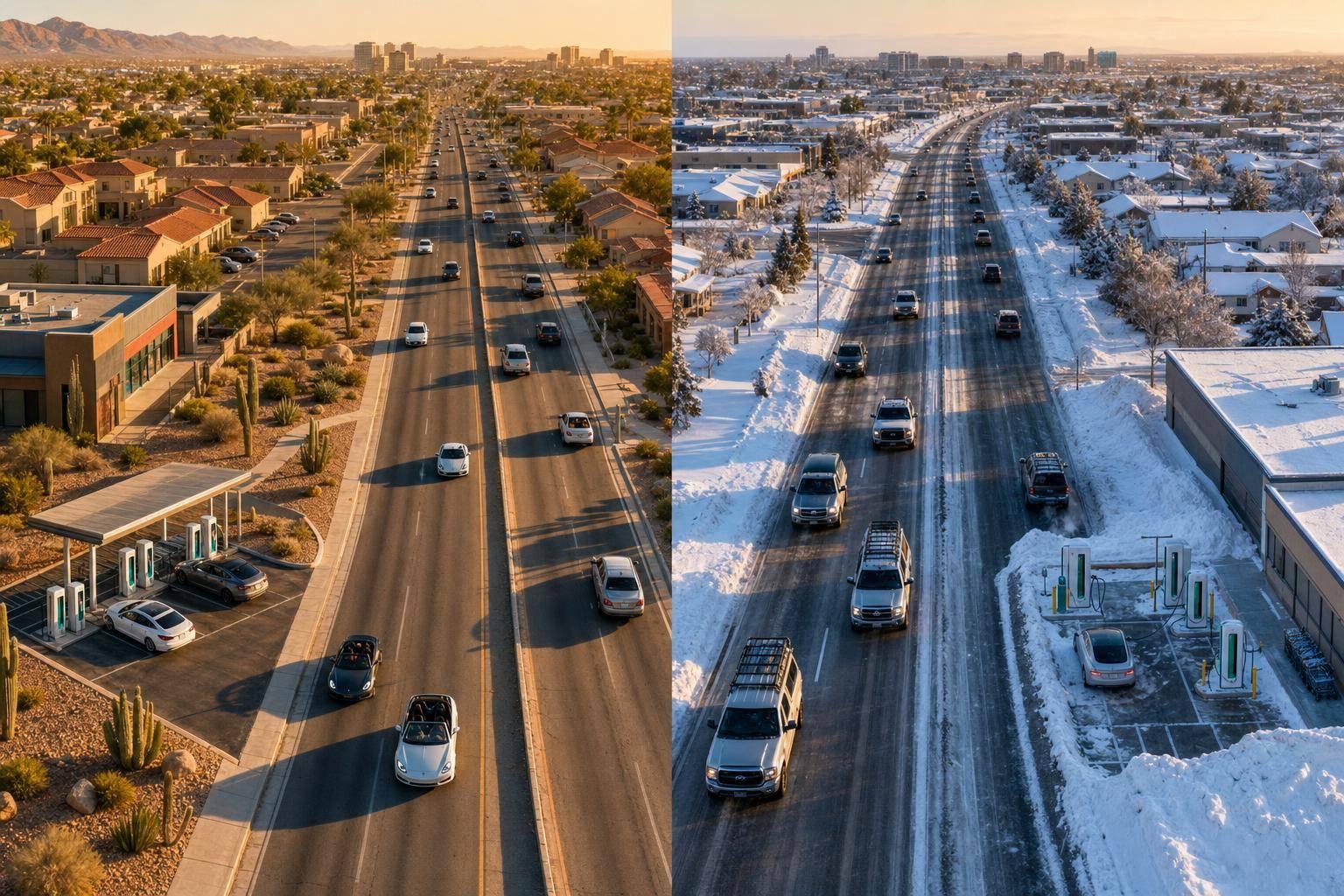
Climate changes what people buy, what they pay, and how fast a vehicle loses condition. In hot states, buyers lean toward cooling features, lighter interiors, and parts that handle heat. In cold states, they focus on AWD or 4WD, winter-ready features, and rust risk from salt.
If I had to boil the whole piece down, it’s this:
- Hot markets favor cabin cooling, UV protection, and heat-resistant components.
- Cold markets favor traction, ground clearance, heated features, and snow performance.
- EV use shifts by climate: cold weather can cut range by 41% at 20°F with cabin heat on, while long-term heat can wear on battery systems.
- Resale is shaped by exposure: salt-heavy regions can corrode vehicles 3–5x faster, while sun damage in hot markets can cost $500 to $3,000+ to fix.
- Local data matters: the same vehicle can carry a different price and risk profile based on ZIP code, weather, and road conditions.
You can also see the split in buyer habits. Pickups and SUVs sell well in both climates, but for different reasons. Sedans and convertibles fit warm regions better, while AWD crossovers, trucks, and snow-ready models hold more appeal in northern states.
The main point: if you price, underwrite, stock, or shop for vehicles without climate context, you miss part of the story.
Hot vs. Cold Climate Vehicle Markets: Key Differences at a Glance
Quick Comparison
Area Hot Climate Markets Cold Climate Markets Common states Arizona, Texas, Florida Minnesota, Michigan, North Dakota Main buyer focus Cooling, sun protection, lower cabin heat Traction, heating, winter driving Popular vehicle types SUVs, pickups, sedans, convertibles SUVs, pickups, AWD crossovers Drivetrain lean FWD, RWD, some 2WD trucks AWD, 4WD EV issue Heat strain over time Range drop in low temps Main wear risk UV damage, battery stress, fluid wear Rust, salt corrosion, freeze-thaw wear Resale concern Faded paint, cracked interiors, battery life Underbody rust, brake/fuel line damage
I wrote this intro to give you the whole picture up front, in plain English, before the article gets into the details.
sbb-itb-9525efd
Hot vs. Cold Regions: Which Vehicles Sell Best
Body Style Demand: Pickups, SUVs, Convertibles, and Sedans
SUVs and crossovers lead in both hot and cold parts of the country. But once you look a little closer, local weather and day-to-day driving needs start to shape what people buy.
Pickups do well in both regions, just for different reasons. In the South, buyers often want towing and hauling. In colder markets, trucks earn their keep with winter use and better snow clearance. That helps explain why the Ford F-150 and Chevy Silverado rank among the top sellers in both the Midwest and the South [1][3].
Sedans tend to do better in warm, flatter markets. The Toyota Camry and Honda Accord stay strong across the South and the West Coast [1][7]. Convertibles are much more tied to hot-weather states, especially coastal and Sun Belt markets like Florida [1].
Body style and drivetrain often overlap, but climate doesn't shape them in quite the same way.
Drivetrain Preferences: AWD and 4WD vs. 2WD and RWD
In snowy and mountainous areas, AWD and 4WD are the go-to choices. In warm, flatter regions, buyers lean more toward FWD and RWD. In snow-belt states, many shoppers see AWD as close to a must-have because it adjusts on its own when roads get slick. 4WD with low-range is more common in rural and mountain areas, where unplowed roads and deep drifts call for extra grip [1][2].
Across the South and Southwest, the math is different. Buyers in warmer markets tend to focus on efficiency and lower day-to-day cost [1][2]. And that split shows up in used-car prices too. A Subaru Outback can sell for more in Colorado, while a RWD sedan in a snowy market may lose resale value fast [1][4].
That same regional divide shows up again when you look at EVs and hybrids.
EV and Hybrid Adoption by Climate and Region
In 2025, California reached a 36% EV and hybrid adoption rate, helped by ZEV mandates and a large charging network. Texas, even as one of the biggest vehicle markets in the country, was at 14% [1].
Cold weather creates a clear hurdle for EVs. Battery range can fall by an average of 41% at 20°F when cabin heat is running [7]. Even so, EV sales are growing in colder states. The Tesla Model Y is now a top-five model in the Northeast, due in part to better battery thermal management and pre-conditioning features that let drivers heat the cabin while the vehicle is still plugged in [1][2].
In hot climates, the issue changes. Long stretches of high heat put pressure on battery thermal management systems, which can affect performance and resale value over time [4][5]. Hybrids often do well in these conditions, especially in heavy traffic. The Toyota RAV4 Hybrid became the top-selling vehicle in Florida and North Carolina, with buyers drawn to fuel savings on long commutes [3].
Those buying patterns lead straight to another layer of the market: the features people care about most in each climate.
Feature Preferences: Comfort, Safety, and Durability by Climate
Hot Climate Priorities: Cooling, UV Protection, and Interior Wear Resistance
In hot climates, buyers care most about keeping the cabin cooler and slowing sun damage inside the vehicle. And for good reason. A parked car can heat up FAST: the cabin can climb 20°F in just 10 minutes in direct sunlight, and after 90 minutes, the interior can get nearly 48°F hotter than the outside air [6]. When heat hits like that, a few features stop feeling optional.
Ventilated seats sit high on the list. They move cooled air through the seat material, which helps cut down on sweat, trapped heat, and that sticky feeling you get after even a short drive. They used to show up mostly in higher-end vehicles, but now they’re much more common in mainstream models [8].
Ceramic window tint is another feature many hot-climate buyers look for. Good ceramic films can block up to 97% of infrared light. That can help keep dashboards up to 20°F cooler, while also reducing UV-related fading and cracking on interior surfaces [8].
Interior color and material matter too. Light-colored cabins and UV-resistant materials tend to age better than dark surfaces that soak up heat [2].
Cold Climate Priorities: Heating, Traction, and Winter Readiness
In colder parts of the country, buyers tend to focus on features that help the car feel usable right away. Comfort matters, sure, but so do visibility and grip.
Heated seats, heated steering wheels, and heated mirrors are some of the first things people want. They’re not just nice to have on a freezing morning. They help from the second you get in. A heated steering wheel, for example, warms your hands before the rest of the cabin has time to catch up [2].
Remote start is another in-demand feature in cold climates. In hot states, people use it to cool the cabin. In cold states, it helps warm the engine and clear the windows before you even step outside [6]. For EV shoppers, the closest match is pre-conditioning, which heats the cabin while the vehicle is still plugged in [1].
Then there’s winter driving itself. Snow and ice change the equation. Ground clearance of 7–8 inches helps on roads that haven’t been plowed yet [2], and dedicated winter tires with the Three-Peak Mountain Snowflake rating can deliver up to 30% shorter stopping distances on cold pavement than all-season tires [10]. That’s not a small gap.
These hot- and cold-weather needs show up pretty clearly in feature choices:
Feature Hot Climate Cold Climate Seating Ventilated/cooled seats Heated seats and steering wheel Windows Ceramic tint, infrared-reflective glass Heated mirrors, heavy-duty wipers Tires Heat-tolerant compounds Winter tires (Three-Peak Mountain Snowflake)
Ownership Costs and Resale: Climate Wear in Hot vs. Cold Markets
Features help sell a car. Climate wear often decides what it’s worth later.
Hot Climate Wear: Heat, Sun Exposure, and Fluid Stress
In Sun Belt states, the biggest threats to long-term value usually build up slowly. You may not notice them day to day, but they show up fast at trade-in or appraisal time. UV radiation degrades paint finishes, cracks dashboards, and turns interior plastics brittle [9].
Once that damage is there, the bill can sting. Cosmetic sun damage alone can cost $500 to $3,000+ to fix [13], and that’s before anyone checks the engine bay.
Heat is also hard on batteries. Under-hood temperatures in the Sun Belt can climb past 200°F, which causes the liquid electrolyte in standard lead-acid batteries to evaporate [11]. In very hot conditions, battery life usually drops by 30% to 50% compared with temperate areas [9]. Tucson ranks among the highest for battery replacement rates [15]. For used inventory in hot markets, sealed AGM batteries make more sense because they handle heat-driven electrolyte loss better than standard batteries [11].
Fluids take a hit too. Engine oil oxidizes faster, transmission fluid wears out sooner, and cooling systems stay under more strain. In plain English, heat makes the whole system work harder. Shorter fluid service intervals can help avoid costly rebuilds [14].
Cold-weather wear is a different story. The big problem isn’t sun damage. It’s corrosion.
Cold Climate Wear: Corrosion, Salt Damage, and Winter Component Strain
In cold markets, value loss usually comes from rust, salt, and freeze-thaw stress. Road salt and liquid brine do most of the damage. Modern brine gets deeper into undercarriages than older dry salt methods, which means brake lines, fuel lines, and electrical connectors take more abuse [11]. In the Northeast, road salt brine is used for more than 180 days per year [12], and vehicles there corrode at a rate 3–5x faster than similar vehicles in Sun Belt states with the same mileage [12].
That history matters a lot at resale. A 5-year-old vehicle from a snowy state can have more structural damage than a much older vehicle from a salt-free area [2]. So for valuation teams, age and mileage only tell part of the story. Corrosion exposure needs its own adjustment. The Toyota RAV4 Hybrid's "Cablegate" issue is a clear example: road salt can corrode exposed high-voltage connectors and lead to repair bills in the thousands [11].
Freeze-thaw cycles pile on even more wear. The NJ/NY/CT corridor gets 40–90 freeze-thaw cycles each year [12]. That speeds up failure in wheel bearings, control arm bushings, and suspension parts, especially on vehicles with sport suspensions or low-profile tires [12]. For fleet operators in these markets, lanolin-based rust inhibitors do a better job than rubberized undercoatings, which can crack and trap moisture [11].
Using CarsXE Data to Measure Regional Climate Trends
Climate-driven vehicle behavior only matters if teams can measure it with structured data.
What to Track in a Climate Trend Dataset
To compare hot and cold markets in a reliable way, track three things for each record: the vehicle, the location, and the climate exposure tied to it.
Start with vehicle-level fields such as drivetrain, body style, ground clearance, and climate-specific feature packages. That includes cold weather packages, plus hot-climate items like ventilated seats and UV-resistant materials. Then tie each record to ZIP code and state, and add climate exposure variables like average temperature in °F, annual snowfall in inches, and whether the area sits in a salt-heavy road region.
History and condition indicators matter just as much. Vehicle history and recalls can point to climate-linked wear, such as underbody rust in salt-heavy markets or battery degradation in hot regions. For valuation work, track regional market value in U.S. dollars and 3-year depreciation rates too. Depreciation changes by climate zone. Texas vehicles, for example, depreciate at roughly 39% over three years, compared with 32% for similar vehicles in New York City [1].
How CarsXE APIs Support Regional Vehicle Analysis
Those same climate signals only become useful when they're tied to VIN, value, history, and recall data.
CarsXE provides the core inputs for this kind of analysis across several APIs. The VIN Decoder and Vehicle Specifications APIs return drivetrain, body type, ground clearance, and equipment details. That makes it easier to segment inventory by climate fit. If you're stocking AWD SUVs for the Northeast or putting more focus on cooling-oriented features for Arizona, this is where the filtering begins.
The Market Value API supports regional price comparison, so teams can spot where climate-specific demand is pushing local prices above or below national averages. The Vehicle History and Recalls APIs add another layer. Tie recalls to geography, and you can surface climate-linked corrosion patterns and battery-risk trends.
Conclusion: Key Differences Between Hot and Cold Climate Vehicle Markets
Climate shapes almost every part of vehicle demand - what sells, which features buyers expect, how fast a vehicle wears down, and what it brings at resale. Hot markets lean toward cooling performance, UV-resistant materials, and heat-tolerant parts. Cold markets lean toward traction, winter readiness, and corrosion resistance. These are not small preferences. They show up in model popularity, equipment attach rates, and depreciation curves across U.S. regions.
Regional assumptions won't cut it. Structured, location-linked vehicle data gives teams the climate context they need to price, stock, and underwrite with more precision.
FAQs
Which vehicles hold value best in hot climates?
In hot climates, the vehicles that tend to hold their value best are usually the ones with a strong track record for long-term reliability and solid climate control. That makes sense: extreme heat puts the most strain on those two areas.
Models like the Toyota Camry, Honda Accord, and Ford F-150 often stand out here. People tend to value them because they handle thermal stress well, keep the air conditioning working dependably, and have finishes that hold up over time.
How much does cold weather really affect EV range?
Cold weather can cut EV range by 15% to 35%, depending on the temperature, your driving speed, and how much you use the heater.
The reason is pretty simple: low temperatures slow down battery chemistry. At the same time, the car has to spend more energy on cabin heat and battery temperature management. That extra load adds up fast.
Newer models with heat pumps and more advanced thermal systems can help reduce the hit. Even so, range loss is still noticeable, especially in subzero conditions.
What climate-related damage should I check before buying used?
Focus on wear that matches the climate. It can help you spot trouble early and avoid expensive repair bills.
In cold climates, inspect the underbody, brake lines, wheel wells, and exhaust for rust caused by road salt and brine. Also look for signs of leaks, such as water stains or musty odors.
In hot climates, check belts, hoses, seals, interior materials, the A/C, battery, and tires for damage from heat or UV exposure.
Related Blog Posts
- How Regional Trends Impact Vehicle Depreciation Rates
- Regional Economies Shaping Car Brand Popularity
- Regional Vehicle Demand: Key Cultural Drivers
- How Regional Trends Impact Vehicle Resale Value