How VIN Decoding Supports Local Insurance Compliance

How VIN Decoding Supports Local Insurance Compliance
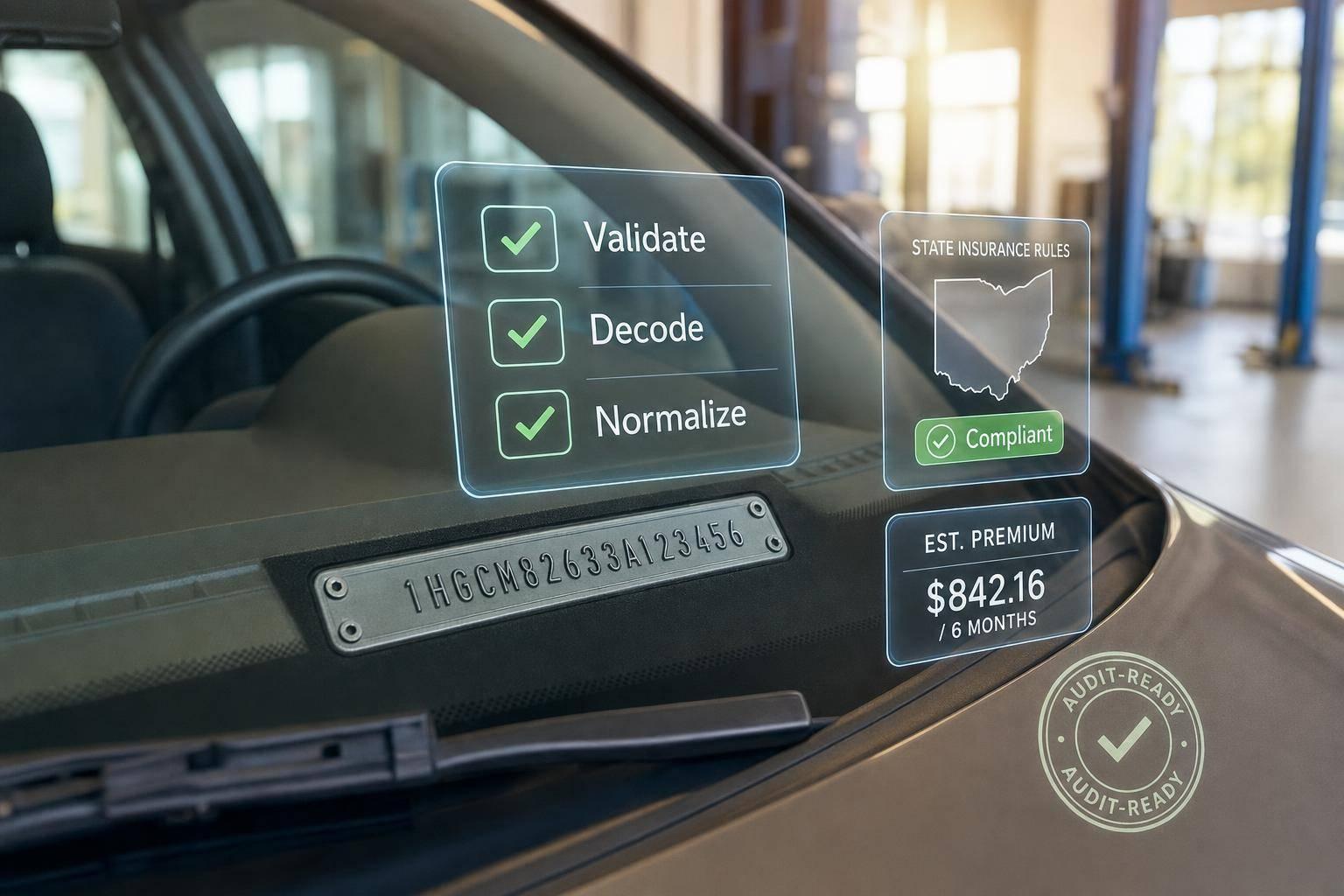
One bad VIN digit can lead to fines, a false lapse notice, or even registration suspension. I’d sum it up this way: if you want local insurance compliance to hold up, you need to validate the VIN early, decode it into the right vehicle fields, map those fields to state rules, and keep an audit trail of every change.
Here’s the short version:
- A VIN is a 17-character vehicle ID, and insurers use it to match the right car, truck, or SUV to the right policy.
- Validation should happen at every intake step: quote, bind, renewal, policy change, and first notice of loss.
- Three checks matter most:
- 17 characters
- allowed characters only
- correct 9th-character check digit
- Decoded VIN data feeds core insurance work, including:
- policy issuance
- proof-of-insurance records
- rating and discounts
- state verification
- reporting
- uninsured motorist checks
- State rules are not the same everywhere in the U.S. Garaging state, title brands, GVWR, safety features, and emissions class can all affect classification, disclosure, and coverage handling.
- Manual handling creates more room for error. Automated decoding helps block bad VINs before they reach filings or DMV matching.
- Audit logs matter. If a VIN or vehicle class is changed, your team should be able to show who changed it, when, and why.
A few points stand out. First, the VIN check digit catches common typing mistakes before they spread through rating and reporting. Second, normalized fields like body style, trim, fuel type, and ABS/ESC flags help keep insurer records lined up across systems. Third, title brands such as salvage, rebuilt, or flood can trigger state-specific disclosure or eligibility rules.
If I were putting this into practice, I’d keep the workflow simple: validate, decode, normalize, map to state rules, store once, and log every edit. That’s the core idea behind using VIN decoding for local insurance compliance.
Map decoded VIN data to compliance use cases
Once you’ve identified the vehicle, the next job is to connect each decoded VIN field to the compliance task it supports. Those fields don’t just sit in a database. They flow into policy documents, rating logic, and regulatory reporting.
Use decoded VINs for policy issuance and proof-of-insurance records
At issuance, decoded VIN data should populate the Declarations Page, policy jacket, coverage forms, endorsements, and certificate of insurance so each record matches the insured vehicle.
Those same fields also feed pricing and discount rules.
Use vehicle attributes for underwriting, rating, and required discounts
Vehicle details like body style, engine size, drivetrain, and GVWR shape classification and rating. Safety features such as ABS, ESC, FCW, AEB, and airbag type may trigger filed discounts or rating rules. If the decoder fails to pick up those features, the discount can be missed, and the rating can drift out of line.
Fuel type and emission class may also affect regional rating rules and green discounts.
Normalized fields also help keep state filings and uninsured-motorist checks aligned.
Use VIN-linked data for regulatory reporting and uninsured motorist monitoring
State statistical-plan filings depend on clean, standardized vehicle data. If body style or vehicle type fields show up differently across records, submissions are more likely to come back with findings. Using normalized attributes from a central VIN decoder helps cut misclassification risk in regulatory data submissions.
VIN-linked history data can include prior insurance details and title brands such as salvage, rebuilt, flood damage, or prior taxi, which may affect eligibility and disclosure under state law [4].
VIN Attribute Compliance Use Case Outcome Safety Features (ABS, ESC, AEB) State-filed discounts Automated application of mandated premium reductions Vehicle Brand (Salvage, Prior Taxi) Risk classification & disclosure Compliance with state-specific policy eligibility rules Emission Standard (ULEV, SULEV) Environmental rating rules Accurate pricing for region-specific green vehicle incentives Body Style & GVWR Statistical-plan reporting Reduced misclassification in regulatory data submissions Prior Insurance History Uninsured motorist monitoring Cross-referenced coverage verification against state data
Once the use cases are mapped, the next step is to build capture, validation, and storage into the intake workflow.
Build a VIN decoding and validation workflow
VIN Decoding Workflow for Insurance Compliance
Local compliance starts with one simple idea: don’t let bad VINs get past intake. If the VIN is wrong at the front door, it can cause trouble later in rating, policy issuance, and state reporting. That’s why clean VIN intake matters so much.
Capture and validate the VIN at every intake point
VINs enter insurance systems at five main points: quote, bind, renewal, policy change, and FNOL. Any one of those can introduce bad data, so validation should happen at every intake point.
Before accepting a VIN, run three checks:
- It must be 17 characters long
- It must contain only allowed characters
- It must pass the mod-11 check digit test on the 9th character [8][9][10][11]
That third check does a lot of heavy lifting. It catches common transcription mistakes, including single-character typos and adjacent transpositions.
If a VIN fails any of these checks, stop processing and route the record to manual review. For online forms, use a plain inline message such as "VIN check digit invalid - please recheck the 9th character". In call-center workflows, agents should confirm the VIN against the customer’s registration or title. If someone overrides the failure, require a documented reason code so the audit trail stays intact [12].
Once a VIN passes validation, decode it into normalized fields for policy and reporting systems.
Decode, normalize, and store compliance-ready vehicle attributes
A decoded VIN isn’t ready for compliance the moment it comes back from a decoder. First, those values need to be mapped to the internal fields used for rating and filings.
The decoder response should include items like model year, trim, plant code, and safety or ADAS details such as airbag setup, ABS, ESC, forward collision warning, and adaptive cruise control.
Here’s where things often get messy: raw decoder values don’t always line up with internal system fields. A decoder might return a trim value that doesn’t match the class names used in your rating platform. So you need a normalization layer to translate those raw values into standard internal categories.
Crosswalk tables usually handle that mapping. If a value doesn’t map cleanly, flag it for data steward review before it gets into a filing or statistical plan submission. That step can save a lot of downstream cleanup.
Store the normalized attributes in one central vehicle record that policies, endorsements, renewals, and claims all use. That keeps teams from working off different copies of the same vehicle data.
A single API plus a batch workflow can also cut cleanup work for both new business and older records.
Use CarsXE to simplify integration and bulk record cleanup
CarsXE provides a RESTful API for VIN decoding, structured specs, batch cleanup, and audit control, with data covering more than 50 countries, including the U.S. The /specs endpoint returns structured JSON fields like make, model, year, body_type, engine_manufacturer, and safety fields such as abs and electronic_stability_control, which can map straight into policy administration schemas [7].
If you need deeper attributes, use deepdata=1. You can also control international decoding when local rules require a strict VIN reject [7].
For legacy books of business, CarsXE’s batch tools help operations teams run large volumes of existing VINs through the decoder in a systematic way. That makes it easier to fill in missing trim data, correct outdated classifications, and flag invalid VINs before a state filing. Organizations, role-based access, usage monitoring, and logs help support audit control [6].
sbb-itb-9525efd
Localize compliance workflows across jurisdictions
After normalization, tie each VIN record to the state where the vehicle is garaged. That state then sets the rules for classification, disclosures, and filings. The next step is simple in theory but messy in practice: take the decoded vehicle record and map it to that state's garaging, classification, and disclosure rules.
Map decoded vehicle data to U.S. state rules and garaging data
Start by comparing the declared garaging address with historical state codes found in title and lien data. That helps flag garaging mismatches or classification issues [4][3].
State-specific title brands matter too. VIN decoding can surface brands like Salvage or Flood damage, and those may trigger required disclosures or affect whether coverage can be issued [4]. Pulling from the brandsInformation array in vehicle history data makes those disclosure triggers easier to automate, instead of leaving them to manual review [4].
VIN Attribute Compliance Use Case State-Specific Example GVWR Vehicle classification Aligns with state-specific passenger versus commercial vehicle definitions [3] Title Brand Code Coverage eligibility "Salvage" status may limit coverage options in states like California [4] Location State Code Garaging verification Compares historical title/lien locations with the declared garaging address [4][3] Emission Standard Regulatory compliance Maps to LEV, ULEV, and SULEV tiers for state environmental rules [2] Safety Features Mandatory discounts Triggers state-required premium discounts for ABS and airbags [2][3]
Normalize trims, safety features, and classification fields
Once garaging checks are done, standardize the fields that drive rating and filings. State filings depend on consistent body style, class, and safety flags. Build mapping tables for the fields that tend to vary the most across states:
- Body style
- Fuel type
- Vehicle class
- Safety feature flags
Then convert detailed equipment descriptions into simple yes/no flags, like ABS present or not, or ESC present or not, so underwriting rules can handle them the same way every time [5].
For weight, store both curb weight and GVWR in pounds. Also tag each record with the matching vehicle class, such as Class 1: 6,000 lb or less, so filings stay aligned [5].
When a field doesn't cleanly fit a state's format, flag it for manual review before filing [2][5].
Apply access controls, audit logs, and data handling rules
Once those mappings are set, lock them down with audit controls and role-based access. Track every VIN, garaging, and classification change with audit logs so regulators and auditors can trace each decision step by step [1].
Manual VIN handling vs. automated decoding: a compliance comparison
Even if your team has a decent VIN process, manual record handling can still leave a big compliance gap.
The risk isn’t abstract. Manual VIN handling can lead to pricing mistakes, filing issues, and weaker fraud checks. Automated decoding cuts down that risk by checking the VIN early and turning vehicle details into a standard format.
You see the gap most clearly in four places: pricing, filing, fraud review, and audit response.
Compliance risk comparison table
Compliance Area Manual VIN Handling Automated VIN Decoding Pricing Accuracy Mis-rates vehicles; misses trim and safety data [1] Premiums based on exact vehicle configuration [1] State Verification Success Higher filing rejection risk [1] Automated mapping of vehicle data to state rules reduces rejections [2] Reporting Reliability Invalid VINs reach filing systems [2] Check-digit validation catches invalid VINs before filing [2] Fraud Detection Support Branded titles and history issues are easier to miss [4] Detection of branded titles and history flags [4] Audit Readiness Weak traceability of edits and data source Built-in audit logs and access controls [13] Administrative Workload High; manual vehicle-spec checks at every step [1] Low; data retrieved in seconds [1]
Key takeaways for implementation
Accurate VIN capture helps stop rating and filing errors before they spread. If the wrong trim, safety feature, or emissions detail gets attached to a record, that bad data can move from quote to filing in no time.
Decoded safety and emissions data also help keep discounts and state rules in sync. That matters because even a small mismatch can turn into a rejected filing or a pricing issue later on.
CarsXE can support VIN decoding and batch cleanup without adding manual review overhead.
That’s why VIN controls should stay built into intake, decoding, and storage. If those checks happen only at the end, teams are stuck fixing problems that should’ve been blocked at the start.
FAQs
Why is the VIN check digit important for insurance compliance?
The VIN check digit matters because it helps confirm that a 17-character VIN is valid and typed in the right way. It uses a standard algorithm, so systems can spot typos or invalid VINs as soon as someone enters them.
That matters a lot in insurance. Clean VIN data helps keep records accurate and dependable for risk assessment, premium pricing, and fraud detection. Just as important, it stops bad data from getting into insurance systems in the first place.
Which decoded VIN fields matter most for state-specific insurance rules?
The most important decoded VIN fields for state-specific insurance compliance are make, model, model year, engine type, body type, and weight class.
These standard vehicle details help insurers confirm the car or truck’s specs for risk review, premium pricing, and coverage checks.
Safety features and trim details can also fine-tune pricing so it lines up more closely with the driver’s risk profile.
When should insurers validate and decode a VIN in the policy workflow?
Insurers should validate and decode a VIN at the point of entry in the policy workflow. That simple step helps keep data clean, catch mistakes early, and support quote generation during the application process.
It also pays to keep validating and normalizing VIN data later in the workflow. This matters during coverage verification and claims, where consistent data helps protect integrity, improve risk assessment, cut fraud, and avoid manual delays.
Related Blog Posts
- How VIN Decoding Powers Compliance Verification
- VIN Decoding for Emission Compliance Tracking
- How VIN Decoding Retrieves Vehicle Specs
- How VIN Decoding Helps with Import Compliance