Customs Compliance with VIN Decoding

Customs Compliance with VIN Decoding
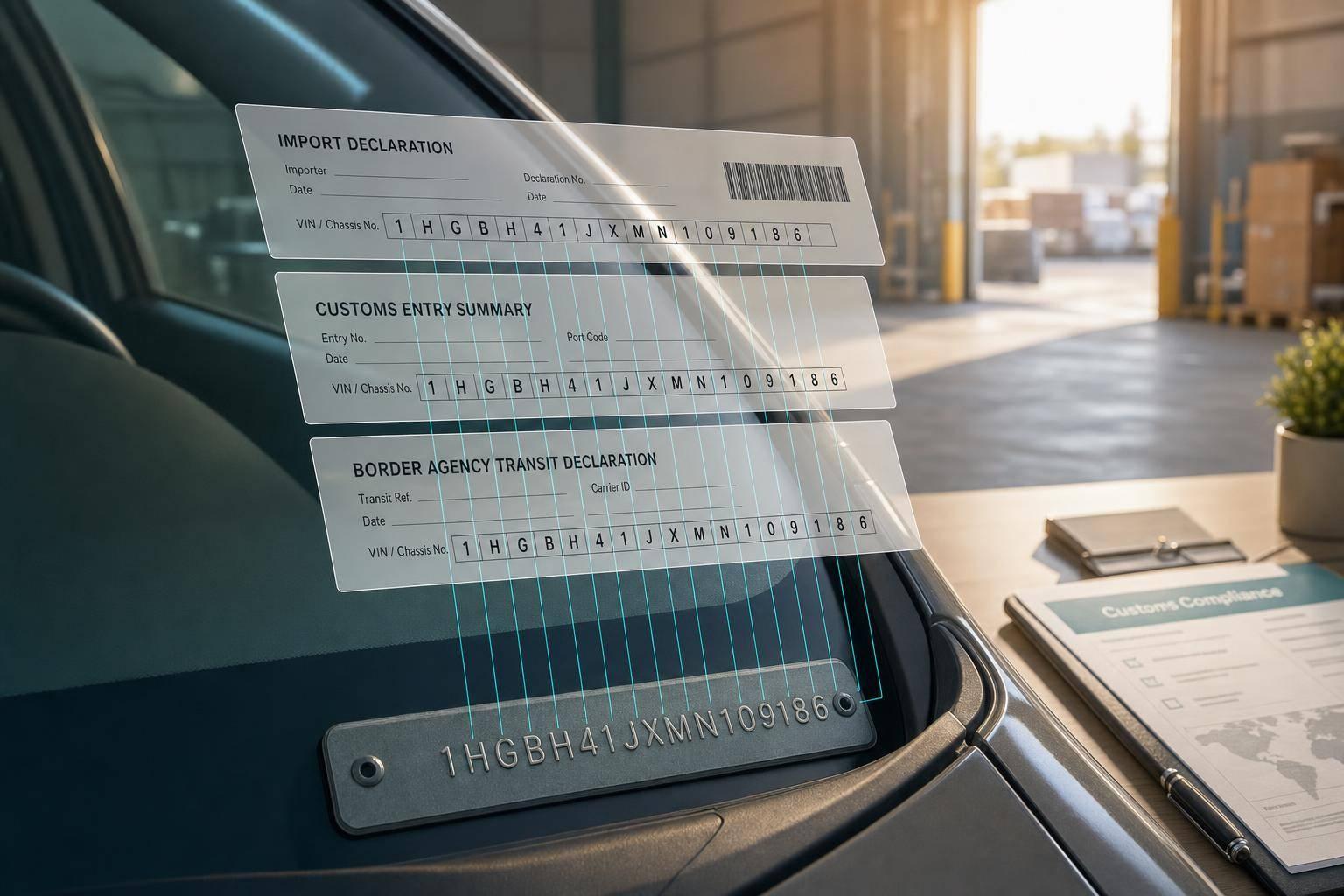
If the VIN is wrong, the whole vehicle filing can go off track. I’d boil this topic down to three things: decode the VIN early, match it across every form, and use it to check classification, duty, age-based rules, safety, emissions, and fraud risk before filing.
Here’s the short version in plain English:
- VIN decoding helps identify the vehicle: make, model, year, engine, fuel type, body style, plant, and build country.
- That data affects customs entry: it helps determine the right Chapter 87 tariff code, duty treatment, and whether the declared value makes sense.
- The VIN must match across records: CBP entry data, title, bill of sale, HS-7, and EPA records.
- Small errors can trigger big delays: one wrong digit, missing GVWR, or wrong fuel type can lead to holds, document requests, back duties, interest, or penalties under 19 U.S.C. § 1592.
- VIN checks also screen for import problems: gray market status, salvage or junk history, theft records, recall issues, and cloned VINs through the 9th-digit check digit.
- Age matters: vehicles 21+ years old may qualify for some EPA exemption paths if unmodified, and vehicles 25+ years old may fall under age-based DOT treatment.
- At scale, teams should automate it: decode VINs in broker, TMS, and compliance systems before filing, store the results, and send mismatches to staff for review.
A few facts stand out. NMVTIS tracks 250+ title brands, and batch recall screening can cover up to 10,000 VINs at once, which shows how much of vehicle compliance now depends on clean identity data.
If I were setting up a simple control plan, it would be this:
- Collect the VIN at booking or pre-alert
- Decode it before entry filing
- Match decoded data to invoice, title, CBP, EPA, and DOT forms
- Check HS code, age rules, and branded history
- Hold exceptions until a person clears them
- Keep time-stamped logs for audit review
This article explains how those checks help cut filing errors, lower duty and penalty risk, and keep vehicle entries moving with fewer surprises.
VIN Decoding for Customs Compliance: 6-Step Control Plan
Using a VIN Decoder to Find a Vehicles GVWR! Great tool for Fleet Managers and Compliance Tracking!
sbb-itb-9525efd
How VIN Decoding Supports Classification, Duty, and Valuation
After VIN verification at filing, the next step is to use the decoded vehicle data to choose the right tariff classification. Once customs teams confirm the VIN data, they lean on it to classify the vehicle and calculate duty. This is the point where VIN decoding hits customs most directly.
Using VIN Data to Select the Right HS Code
Vehicles sit in Chapter 87, but the right heading depends on what kind of vehicle you're dealing with. HTS 8703 covers passenger vehicles, while HTS 8704 covers vehicles used to transport goods. Decoded VIN details like fuel type, engine displacement, GVWR, and body style help customs teams land on the right heading and subheading.
That matters more than it may seem at first glance. A battery-electric sedan and a gasoline-powered light pickup might have the same declared value, but they can fall under different headings. Same value, different classification, different duty outcome.
Model year can also shape special tariff treatment, including 25-year exemptions [6].
What Happens When VIN Data Is Incorrect or Incomplete
When VIN data is wrong or missing, the problem often shows up after filing, once CBP starts comparing records. A missing GVWR field can push a vehicle into the wrong category. An incorrect fuel type can put it in the wrong subheading. And once that happens, things can slow down fast: a customs query, a request for more documents, or a shipment hold until someone clears up the mismatch.
Misclassification can lead to back duties, interest, and civil penalties under 19 U.S.C. § 1592 [5]. Wrong VIN-based valuation can also create undervaluation risk, especially when the declared model or trim doesn't line up with the decoded VIN.
Put simply, the day-to-day impact shows up in classification accuracy, duty exposure, and clearance speed.
Accurate VIN Decoding Incorrect or Incomplete VIN Data HS Code Selection Driven by verified vehicle type, fuel type, GVWR, body style, and engine size High misclassification risk; relies on incomplete descriptions or assumptions Duty Calculation Correct rate applied to the properly classified vehicle Underpayment or overpayment; back-duty exposure Valuation Support Decoded trim and specs help confirm whether the declared price is reasonable Mismatch between declared model and actual configuration raises undervaluation risk Compliance Risk Lower; verified vehicle data supports audit review Higher; clearance holds, requests for information, and potential penalties Clearance Speed Faster; data aligns across filings and supporting forms Slower; document requests and inspections extend port dwell time
Where VIN Data Appears in U.S. Customs and Regulatory Filings
In a U.S. vehicle import, the VIN has to line up across the customs entry, title, and compliance forms. After the VIN is decoded, the next checkpoint is simple: does every document show the exact same VIN?
VIN on Customs Entry Documents and Supporting Records
When a vehicle enters the U.S., CBP uses the VIN to confirm identity, model year, and origin for duty and admissibility review. That same VIN also needs to match the bill of sale or invoice and the vehicle title. A one-character typo or transposed digit can be enough to cause a mismatch, which may lead to a request for information or a manual hold.
Vehicle titles use the VIN to track ownership and branded history, including salvage, flood, or rebuilt status [2]. Bills of sale connect the payment record to the exact vehicle being imported. Compliance teams use the VIN the same way, linking vehicle history records to the import file.
EPA and DOT Forms Tied to Vehicle Import Compliance
U.S. vehicle imports also go through safety and emissions review alongside the customs entry. For NHTSA/DOT compliance, the VIN is required under 49 CFR Part 565 and used to verify manufacturer information under 49 CFR Part 566 [8]. HS-7 uses the VIN to verify FMVSS compliance [8].
On the emissions side, VIN decoding can show a vehicle's emission tier, such as LEV, ULEV, or SULEV, which supports EPA compliance review [1]. It can also show gray market brand codes. Brand 45 means the vehicle was made for use outside the U.S. and may not meet federal standards. Brand 46 means it does meet federal standards [2]. That small detail can make a big difference before filing.
Those same VIN checks also feed the eligibility and fraud screening that comes next.
How Missing VIN Data Causes Filing Problems
Missing VIN data or a mismatch can lead to rejection, a hold, or a request for information. If the VIN is missing from a required field, CBP may reject the filing outright or place the vehicle on manual hold until more documents are provided. If the VIN appears one way on the customs entry, another way on the title, and differently again on the HS-7 form, that alone can trigger a request for information.
At filing, these records need to match exactly.
Filing Document VIN Required? Purpose Customs Entry (CBP) Yes Verifies identity, model year, and origin DOT Form HS-7 Yes Confirms FMVSS compliance [8] Vehicle Title / Bill of Sale Yes Tracks ownership and branded history [2] EPA Emissions Records Yes Verifies emission tier for environmental compliance [1]
Using VIN Decoding to Check Eligibility, Emissions, Safety, and Fraud Risk
Import Eligibility and Regulatory Screening
Once the VIN matches the filing records, the next move is to screen admissibility before the vehicle reaches entry.
A VIN decoder can use model year, build date, engine, fuel type, body style, and country of origin to flag vehicles that may need EPA, DOT, or age-based exemption review [14][12][13].
For example, vehicles that are at least 21 years old and still in original, unmodified condition may qualify for an emissions exemption under Form 3520-1, code E [12][13]. But there’s a catch: a replacement engine can wipe out that eligibility. VIN decoding helps spot the engine setup early, which gives compliance teams a reason to take a closer look before anything gets filed.
For vehicles under 25 years old that were not built to FMVSS, VIN decoding can also flag entries that need NHTSA eligibility review and HS-7 documentation [11][4].
Those same data points do double duty. They help with admissibility, and they help surface fraud and title-history issues before filing starts.
Fraud Detection and Restricted Vehicle Checks
VIN decoding can also surface salvage, theft, and gray-market issues that plain paperwork may miss.
NMVTIS recognizes more than 250 title brands. And once a brand is tied to a VIN - whether it is salvage, flood, rebuilt, junk, or theft - it stays in the record for good, even if a later state issues a clean title [16][17]. Brand codes 45 and 46 can flag gray market vehicles built for use outside the U.S. that may not meet federal standards [2]. If a gray-market VIN shows up on a domestic-spec filing, that’s a clear conflict and should stop the entry.
Cloned or altered VINs are another major problem. The 9th VIN character is a check digit. A decoder that validates that position can quickly flag a VIN that does not follow standard manufacturing logic, which may point to a fraudulent or reassigned identifier [3]. CBP has documented cases where officers found fraudulent VINs by working with state and provincial DMVs, which shows just how closely vehicle identity gets examined at the border [15].
The table below shows what strong VIN decoding can catch before filing.
Compliance Check Benefit of Thorough VIN Decoding Risk of Weak or Manual Checks Age-Based Exemption Confirms whether the vehicle meets EPA and DOT age thresholds [12][14] Filing for exemptions the vehicle does not qualify for Gray Market Status Flags brand codes 45/46 for non-U.S.-spec vehicles [2] Importing vehicles that fail EPA/DOT standards Theft Detects active theft records before entry [9] Seizure of vehicle; legal liability for stolen property Title Brands Identifies salvage, flood, rebuilt, or junk status permanently tied to the VIN [16][17] Clearing vehicles with hidden damage or restricted status Safety Recalls Surfaces active NHTSA recalls, including stop sale and do not drive advisories [7] Importing vehicles with unresolved life-safety defects VIN Integrity Validates check digit to detect cloned or altered VINs [3] Mismatched paperwork, customs holds, or fraud exposure
Once those risks are flagged, the next step is to wire VIN checks into broker and compliance workflows before filing.
Building VIN Decoding Into Customs Workflows
Connecting VIN APIs to Broker, Logistics, and Compliance Systems
Once eligibility and fraud checks are done, the next move is simple: build VIN checks right into the systems your team already uses. That means broker platforms, TMS tools, and compliance software should decode VINs automatically so key vehicle details fill in and verify filing fields in real time.
When someone scans or enters a VIN, the system should pull decoded data and use it to fill in or check fields like:
- vehicle type
- engine type
- fuel type
- GVWR
- country of origin
- HS code selected for the entry
The main goal is to make VIN decoding a pre-filing validation step. Before anything is submitted, compare the decoded vehicle data with the declared entry data. If something doesn’t match, flag it for review.
For teams working with larger volumes, batch requests help a lot. Caching repeat VINs also cuts delay and lowers API calls [10].
How CarsXE Can Support Multi-Country Vehicle Compliance Workflows
For cross-border imports, getting a VIN decoded is only part of the job. You also need normalized vehicle data. Without that, filings across countries can end up with mismatched or messy records.
CarsXE provides VIN decoding and related vehicle data across 50+ countries, which helps teams standardize attributes before applying country-specific tariff and compliance rules [18].
A U.S.-based importer moving vehicles from Europe, Asia, or Latin America can use CarsXE's International VIN Decoder to standardize details such as plant country, emission standard, and engine specs. From there, the team can apply the right tariff and regulatory rules for each market on top of the normalized data.
The Recalls Batch API supports up to 10,000 VINs in one request, making fleet-level safety screening practical at scale [10]. CarsXE also offers a 7-day free trial with no credit card required, so development teams can test integrations before moving to a production plan [19].
Conclusion: Key Controls for More Accurate Customs Filings
Consistent, verified VIN data affects every part of a customs filing: classification, valuation, eligibility screening, documentation, and fraud detection.
When VIN decoding is built into workflows early - ideally at booking or pre-alert - teams can catch attribute mismatches before they ever reach CBP. The core controls are straightforward:
- require VIN capture for all applicable vehicle imports
- validate decoded data automatically against declared HS codes and regulatory requirements
- send exceptions to qualified staff before submission
It also helps to keep strong audit logs. Store decode responses, rules applied, and decisions made with timestamps. That gives compliance teams a clear, repeatable process they can show regulators if questions come up.
FAQs
How early should I decode a VIN before filing?
For customs compliance and regulatory filing, decode the VIN as early as possible. Doing it up front helps improve accuracy and makes audits a lot easier to handle.
An automated tool like the CarsXE VIN Decoder API can cut down on manual entry mistakes, flag validation issues in real time, and keep filing data consistent and verified.
What documents should the VIN match across?
For customs compliance, the VIN needs to match across all official import and export documents, including:
- the manufacturer's certificate of origin
- commercial invoices
- the bill of lading
- official vehicle registration records
That match helps customs confirm the vehicle's details and keeps processing and regulatory checks on track.
Can VIN decoding help catch gray market or salvage vehicles?
Yes. VIN decoding and related vehicle data can help identify gray market or salvage vehicles by showing branded titles like junk or dismantled.
A VIN check and vehicle history report can also show past locations and ownership. That gives you a clearer picture of the vehicle’s status, helps flag red flags, and supports regulatory compliance.
Related Blog Posts
- How VIN Decoding Powers Compliance Verification
- VIN Decoding for Emission Compliance Tracking
- How VIN Decoding Helps with Import Compliance
- How VIN Decoding Supports Local Insurance Compliance