Customs Duty and VAT: Import/Export Checklist

Customs Duty and VAT: Import/Export Checklist
One wrong detail can change the tax bill. If I move a vehicle across a border, I need to confirm the movement type, tariff code, customs value, origin, and filing records before I estimate duty or VAT.
Here’s the short version:
- Permanent imports often trigger customs duty and import VAT in the destination country.
- U.S. exports usually do not face U.S. export duty, but the destination country may still charge tax.
- Temporary moves and returned vehicles may qualify for relief, which can cut or remove duty and VAT.
- The core records must match: VIN, title, invoice, shipping papers, and customs entry.
- Customs value may include charges like ocean freight and marine insurance. For example, a $25,000.00 vehicle plus $1,200.00 freight and $150.00 insurance gives a customs value of $26,350.00.
- If duty is 2.5%, that would be $658.75 on $26,350.00.
- VAT rules differ by country. Some tax the customs value only. Others tax customs value plus duty and fees.
- Relief claims usually need proof, such as prior export records, ownership history, time limits, or temporary admission papers.
- After release, I still need to keep an audit file, because customs can review the entry later.
A few checks matter most before filing:
- What kind of move is this? Import, export, temporary use, or return?
- Is the vehicle new, used, salvage, or rebuilt?
- Does the tariff code match the specs?
- Does origin support any trade deal claim?
- Do all documents show the same VIN and vehicle details?
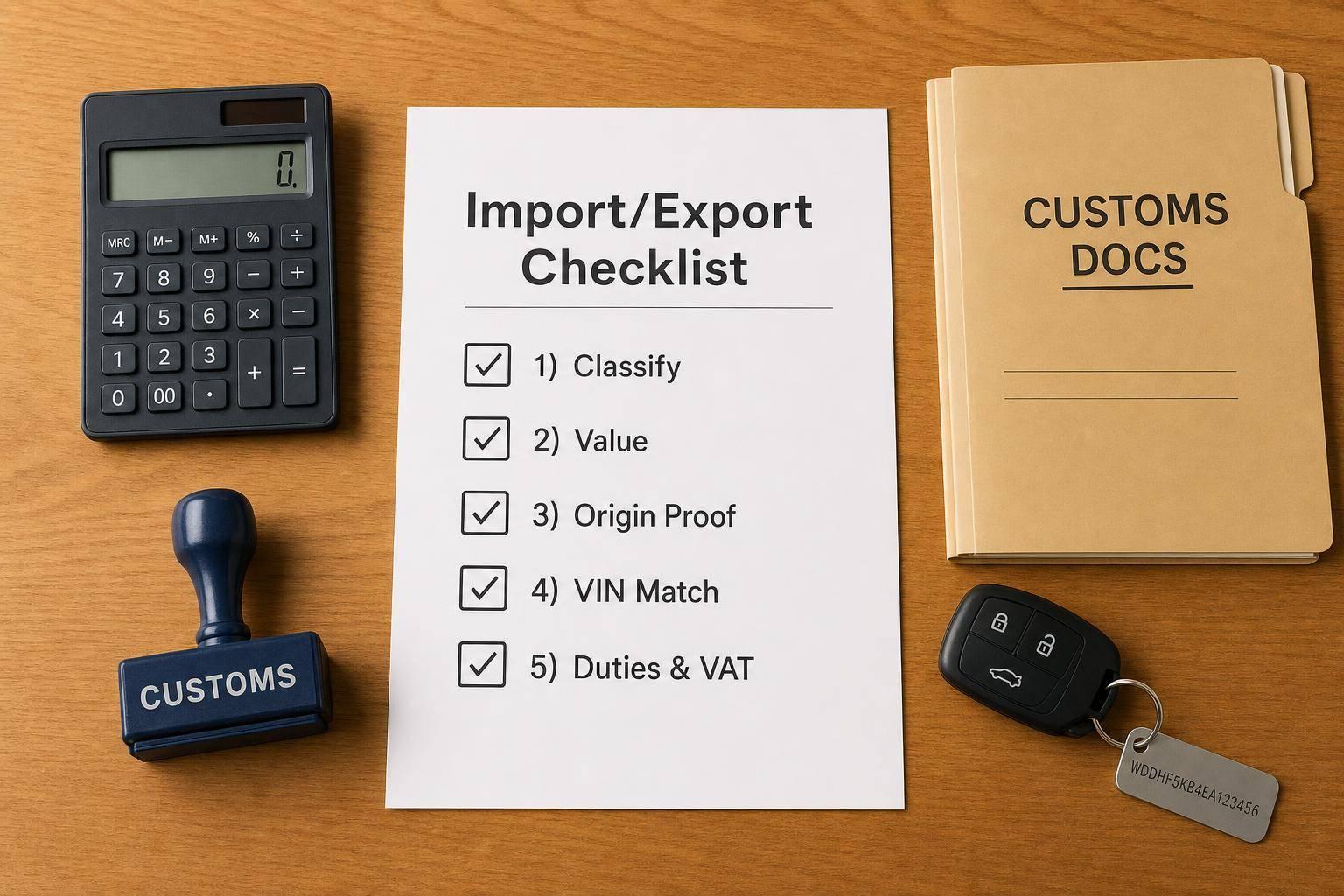
If I had to sum up the whole checklist in one line, it would be this: classify the vehicle, set the value, prove the origin, file the entry, and keep the backup records.
Vehicle Import/Export Customs Compliance: Step-by-Step Checklist
Importing a vehicle?
sbb-itb-9525efd
1. Confirm the Vehicle Transaction Type First
Start by identifying the movement type. That one call shapes duty, VAT, forms, and whether any relief may apply.
Import, Export, Temporary Movement, or Returned Vehicle
Each movement type follows a different customs route:
- Permanent import: Usually triggers duty and destination-country import VAT.
- U.S. export: U.S. Customs and Border Protection does not charge export duty; destination-country taxes may apply.
- Temporary movement: May qualify for temporary admission under an ATA carnet or local temporary import rule.
- Returned vehicle: May qualify for returned-goods relief if prior export and unchanged condition are proven.
Before you estimate charges, record the purpose, duration, and destination. That choice sets the filing path for the next step.
New, Used, Salvage, or Rebuilt Status
The vehicle's condition helps support the declared value. It also tells you whether salvage or rebuilt status needs to be disclosed.
Check VIN history early for salvage, junk, or non-standard import history flags. Those details can change the filing package or even affect import eligibility. CarsXE's VIN decoding and vehicle history tools can help surface these status flags and condition details upfront, so there are fewer surprises at the border.
Check for Reliefs Before Calculating Charges
Screen for reliefs during planning, not after you've already built a landed cost estimate. For vehicle traders, three reliefs matter most:
Relief Type Typical Eligibility Conditions Transfer of Residence (ToR) Permanent move, owned and used for 6+ months, imported within 12 months, not for resale [8] Temporary Import Relief Temporary use, re-export within the allowed period, bond or carnet required [6][10][11] Returned Goods Relief Previously exported from the same country, re-imported unchanged within 3 years by the same owner with proof of prior export [7][9][12]
On every shipment, ask three simple questions before you lock in charges:
- Is the owner relocating?
- Has this vehicle been exported from this country before?
- Is the stay temporary and the vehicle expected to be re-exported within the allowed period?
Every "yes" is a sign to check for a relief before filing. If no relief applies, move to classification and valuation.
Once the movement type is clear, classify the vehicle and set the customs value.
2. Verify Classification, Origin, and Taxable Value
With the movement type confirmed, the next step is to lock down the three inputs customs authorities use to calculate duty and VAT: classification, customs value, and origin. If even one is wrong, you can end up with a reassessment, back-duty, or penalties after clearance.
Confirm the Customs Classification
Customs classification assigns your vehicle a tariff code under the Harmonized Tariff Schedule (HTS). That code sets the duty rate, so a mistake here ripples through the whole entry.
Classification turns on facts like vehicle type, body style, propulsion, weight, and use. VIN data helps back up the code with details such as body class, propulsion, engine size, and weight. CarsXE's VIN decoding and specifications API can standardize those fields. [2]
Use these inputs to support the tariff code:
Classification Input Relevant Data Point Example: 2012 BMW 535i Vehicle Type Body class / NCSA body type Sedan/Saloon, 4-door Propulsion Fuel type / engine configuration Gasoline, In-Line 6-Cylinder Engine Size Displacement (CC / L) 2,979.16 CC / 3.0L Weight GVWR Class 1 (6,000 lbs or less) Intended Use Seats / doors 5 seats / 4 doors Origin Plant country Germany
One common error is declaring a light-duty pickup as a passenger car. Those categories can carry different duty rates, and customs authorities may check the declared tariff code against technical specs and commercial invoices during a post-clearance review. Keep the VIN report, spec sheet, and manufacturer records that back up the code.
Once the code is supported, move to customs value.
Establish Customs Value and the VAT Base
Customs authorities generally use transaction value as the main valuation method: the price actually paid or payable for the vehicle, adjusted for statutory additions where required. [13][14]
If freight and marine insurance are included in customs value, the calculation looks like this:
- Vehicle invoice price: $25,000.00
- Ocean freight: $1,200.00
- Marine insurance: $150.00
- Customs value: $26,350.00
Post-import inland trucking, such as $300.00 from port to dealer, is excluded because it happens after entry. That detail matters. If charges are lumped together, it gets much harder to show what belongs in customs value and what does not. Keep freight, insurance, and domestic transport itemized.
For the VAT or sales/use tax base, check whether local rules apply the tax to customs value alone or to customs value plus duty and other fees. If duty at 2.5% on $26,350.00 equals $658.75, and local rules add duty to the base, the taxable amount becomes $27,008.75. Write down each step: invoice reference, calculation date, and legal citation. If you're ever audited, you want a worksheet that another person can follow line by line.
Then verify origin before filing.
Validate Origin and Trade Agreement Eligibility
Origin is based on manufacture or substantial transformation, not the shipping route or storage location. A vehicle shipped from a trade-agreement country does not automatically qualify for preferential duty. In most cases, preferential treatment requires a certificate or self-certification, not just a shipping claim. [15]
For vehicles, origin rules under trade agreements often require both a tariff shift and a regional value content test. That's the part that counts, not the address on the shipment. If those thresholds are met, the importer may qualify for a reduced duty rate or even a zero-duty rate.
To claim preferential treatment, declare the preference code on the customs entry, attach the certificate of origin or exporter self-certification, and keep a compliance file with supplier declarations and production records. If customs later finds the claim invalid, the importer may face retroactive duty, interest, and potential penalties. [15]
Use VIN decoding to confirm assembly location and reconcile it with the declared origin.
With classification, value, and origin fixed, gather the documents and file the declaration.
3. Prepare Documents and File the Customs Declaration
Once classification, value, and origin are settled, the job turns into paperwork. This is where small errors can cause big headaches. If documents are missing, or if one record doesn’t line up with another, customs can delay release and push back on duty, VAT, or origin claims. The safest move is simple: keep one complete file that supports all of those claims.
Collect the Required Import or Export Documents
For a U.S. vehicle import, CBP expects a core set of documents at entry. That usually includes the commercial invoice or bill of sale with the buyer, seller, price, currency, and Incoterms; the title or proof of ownership; any foreign registration documents if the vehicle was registered abroad before; the bill of lading or air waybill; and CBP Form 7501 (Entry Summary), plus CBP Form 3461 when needed. Most vehicles also need EPA Form 3520-1 and DOT Form HS-7, unless an exemption applies, such as a vehicle covered by an EPA Certificate of Conformity. If you’re asking for preferential duty treatment, include any certificate of origin or trade agreement documentation too. [3][5][21]
For exports, the paperwork changes a bit. You’ll still need the commercial invoice and a title or other proof of ownership. For self-propelled vehicles, that title must be presented to CBP at least 72 hours before departure. You may also need an Electronic Export Information (EEI) filing through the Automated Export System (AES/ACE) when value thresholds or export controls apply. [17][18][19] And if the destination country uses VAT, keep proof of export for any zero-rating claim. Without that proof, the tax authority may later treat the sale as taxable. [22]
Keep the invoice, title, transport documents, compliance forms, and proof of origin in one file. It sounds basic, but it saves time when customs, a broker, or a state agency asks for backup.
Match VIN, Title, Invoice, and Shipment Records
Before you file, check that every key detail matches across the full record set. Start with the 17-character VIN, then review the make, model, model year, trim, body type, engine type and displacement, fuel type, gross weight or curb weight, invoice amount, currency, buyer and seller details, title number, and shipment references such as the bill of lading, container, booking, or tracking number.
A single bad character in the VIN or a model year that doesn’t match between the title and invoice can trigger a hold or even a fraud review. That’s why this step matters so much.
API-based vehicle data validation can speed this up. A VIN decoding and specifications API can standardize the make, model, year, trim, engine specs, and plant country from one source, which makes it easier to compare those details against the title, invoice, shipment records, and proof of origin. [1] Query logs also help by leaving an audit trail in case customs questions the declaration later.
Make sure any history flags also line up with the declared vehicle status.
File, Pay, and Confirm Release Conditions
After the documents are checked, submit CBP Form 7501 through ACE and confirm the VIN, tariff classification, customs value, origin code, and duty rate. U.S. imports do not have federal VAT, but they may still face state sales or use tax, MPF, HMF, and, for some passenger cars, gas guzzler excise tax. [20][16]
Charge Type Typical Calculation Base Example Application Customs duty Customs value, adjusted under customs valuation rules Applied at the tariff rate for the vehicle's classification State sales/use tax Varies by state Often due when the vehicle is titled or registered MPF / HMF U.S. import fee structure Assessed when the entry is subject to the fee Gas guzzler excise tax Fuel economy rating Applies to certain passenger cars
Also confirm when payment is due. In some cases, duties and fees must be paid before customs release. In others, a bond or deferred payment setup may already cover the entry. Once the vehicle is released, get and save the stamped CBP Form 7501. State motor vehicle agencies often ask for it when you apply for title and registration. [5][23]
Record the entry number, release message, and any exam notices in the file. That record can matter later. Materially false or negligent declarations can lead to civil penalties, and fraud can reach the vehicle’s full domestic value. [24][25][26]
4. Apply Reliefs, Exceptions, and Post-Clearance Controls
Once classification, customs value, and documents are in place, the next step is simple: check whether an exception changes what’s due.
Not every vehicle movement is charged the same way. Some entries qualify for lower duty. Some may be waived. Others need extra proof before customs will release the vehicle. Use the same VIN, origin, and title file from the earlier steps to back up each claim.
Decision Table: When Duty and VAT Are Due, Reduced, or Waived
The exceptions below fall into three buckets: trade-agreement relief, condition- or age-based relief, and cases where compliance status can slow release.
Trade-Agreement Relief
Scenario Duty Treatment Key Evidence Required Preferential origin under an applicable trade agreement Preferential duty rate may apply Plant country and manufacturer address from VIN data, matched to the invoice [1]
Condition/Age-Based Relief
Scenario Duty Treatment Key Evidence Required Returned goods / warranty return Returned goods relief may apply Historic title abstracts, current title information including the issuing authority and issue date, and manufacturer breach of warranty record [4] Antique vehicle (over 50 years old) Age-based duty relief may apply VIN-verified manufacture date (Code 24) [4] [27] Classic vehicle (over 20 years old) Reduced duty rates may apply Jurisdiction-specific criteria (Code 25) [4] Salvage/junk vehicle Scrap or parts valuation may apply Salvage or junk certificate (Code 08) [4] Rebuilt vehicle Standard duty after repair Anti-theft and safety inspection records (Code 09) [4]
Compliance-Sensitive Cases
Scenario Duty Treatment Key Evidence Required Export with VAT zero-rating Not applicable Export-intent proof [4] Gray-market vehicle (Codes 45/46) May require bonded entry or additional proof of compliance before release Federal compliance status [4]
VAT treatment depends on local exemption, zero-rating, or import-tax rules.
Before you apply any exception, check the title brand and origin against the VIN file [1] [4]. That step can save a lot of back-and-forth later.
Reconcile Charges and Keep Audit Records
After release, compare the final entry with the assessed duty and VAT. The VIN record, origin data, tariff classification, condition status, and final entry should all match. If they don’t, that gap can come back to bite you during review.
Keep the VIN-based fields that support the filing:
- 17-character VIN
- Check digit
- Plant country
- Manufacturer address
- Engine size
- Gross weight
- Number of axles
- Product type
- Fuel type
- Title status
- Title branding information [1] [4]
CarsXE can pull VIN, origin, and spec fields into the compliance file automatically. Market value data adjusted for condition can also help defend the declared customs value during audit [27].
If the vehicle will be exported, verify that there are no active liens or theft reports before clearance. Those problems can stop legal movement and lead to delays that were fully avoidable [27].
Conclusion: Final Vehicle Trade Compliance Checklist
Follow the checklist in order: classify, value, document, file, and keep records. When vehicle data is checked the same way at each stage, clearance tends to move with fewer delays, and the file is easier to defend during review.
FAQs
How do I know if a vehicle move is temporary or permanent?
Check the vehicle’s legal title and ownership transfer record. If the title shows an actual change in ownership - transferred from the recorded seller to the buyer, with a matching title issue or transfer date - treat it as permanent.
If there’s no proper title or ownership transfer into the buyer’s name, and the record shows only a temporary registration or another non-ownership change, treat it as temporary.
What costs should I include in customs value?
The customs value of an imported vehicle usually starts with the transaction price - the amount actually paid, or still payable, for the vehicle.
It also includes costs tied to getting the vehicle to the U.S. point of entry, such as:
- International freight
- Shipping insurance
- Loading and handling charges
When you work out the total landed cost, include more than just the customs value. You’ll also need to add import duties, taxes, and fees.
What proof do I need to claim duty or VAT relief?
To claim duty and VAT relief in vehicle trade, you need clear paperwork that proves the vehicle’s history and current status.
That usually includes:
- A valid title that shows ownership, any title brands, and any active liens
- A written bill of sale that includes the sale date, purchase price, full vehicle details, and both parties’ names, addresses, and signatures
- A VIN report that confirms ownership history, checks for undisclosed title brands or liens, and shows that the vehicle is not listed as stolen
This paperwork helps show that the deal is legitimate and that the vehicle’s record lines up with what’s being claimed.
Related Blog Posts
- How VIN Decoding Helps with Import Compliance
- African Vehicle Import Tax Rules by Country
- Customs Compliance with VIN Decoding
- How APIs Simplify Import Duty Calculations